
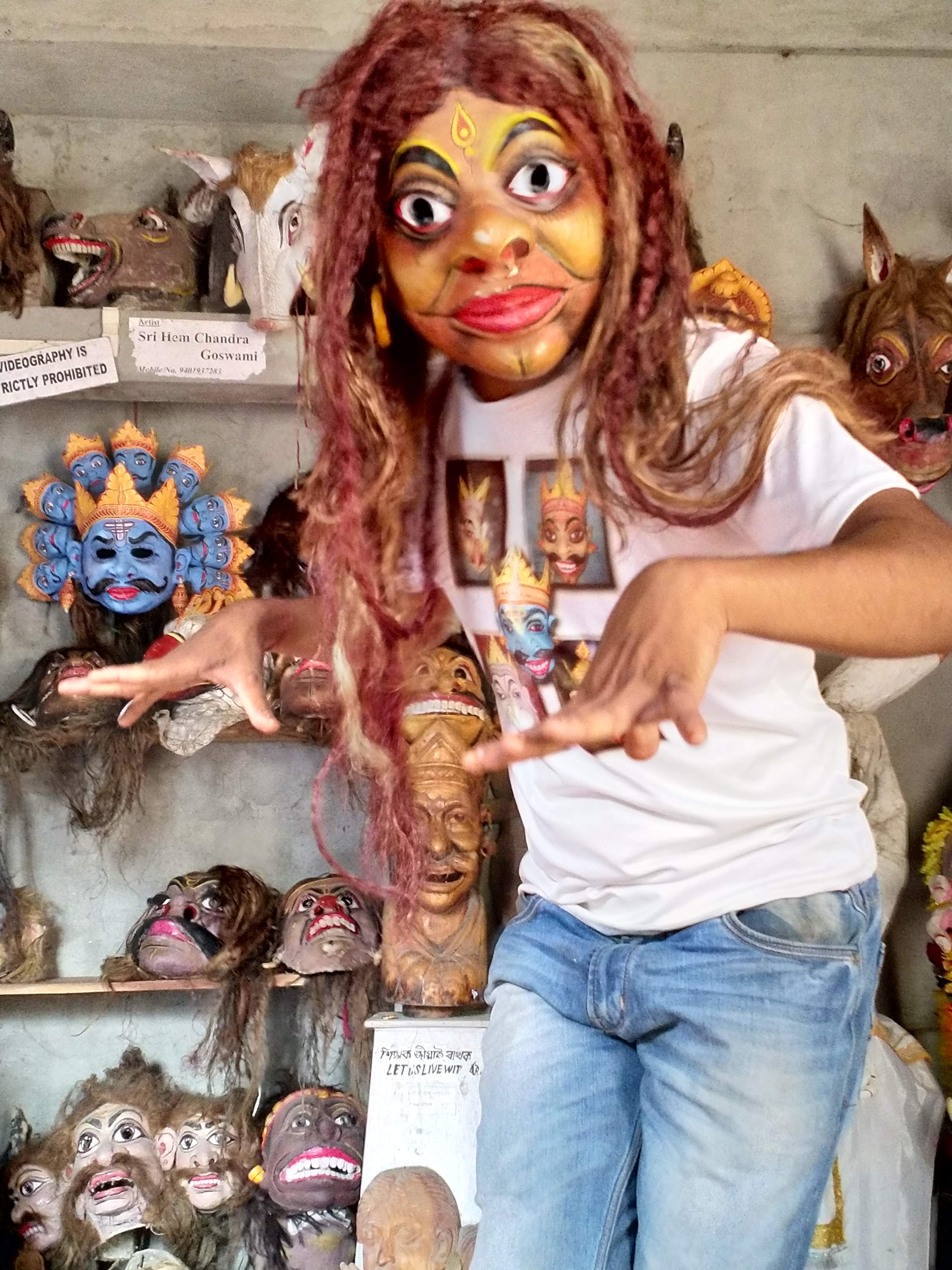
“Masks in Majuli are not just theatre props — they are living artefacts — they enact beliefs, social memory and a careful economy of making.” — paraphrase from interviews with mask artisans in Majuli. (Sahapedia, The Wire)
Why Majuli’s Masks Matter
On Majuli — the great river island set like a green jewel in the Brahmaputra — an everyday object carries extraordinary weight: the mask. These masks attend ritual dramas known as bhaona (Bhaona), perform epic roles in community festivals, and anchor a very specific lineage of craft tied to Assamese Vaishnavite sattras (monastic-cultural centres). Over the last half-century, one name has come to stand for this living tradition: Hem Chandra Goswami. A maker, teacher, innovator and community leader, Goswami’s work has helped a fragile, local craft find new audiences and technical refinements while keeping its ritual heart intact. His recognition by the Government of India (Padma Shri, 2023) is not only personal but symbolic — a small but meaningful spotlight on a vanishing island craft. (Press Information Bureau, Wikipedia)
This article is a deep-dive into the craft and its contexts: who makes these masks, how they are made, what they mean, and how craft, religion, ecology and economy intertwine on Majuli. I draw on interviews, field studies, heritage reports and craft research to paint a textured picture of a living tradition under pressure — and of a practitioner whose practice has helped it endure. (Sahapedia, NIRDPR)
Hem Chandra Goswami — Life, Learning, and a Lifetime of Masks

Born in 1958 in Majuli, Hem Chandra Goswami traces his learning to the sattriya lineage and to a family that practised khanikar (artisan) responsibilities within the sattra (monastic-cultural institution). He received formal training in arts and crafts later, and for more than four decades has combined traditional methods with small but significant innovations: making lighter bamboo-based masks, integrating movable jaws so actors can “speak” through masks, and teaching generations of apprentices. His public profile grew through lectures, workshops and exhibitions across India; in 2023 the state recognized him with the Padma Shri for his contribution to the art.
Several interviews and reports document Goswami’s trajectory: he trained as a child under his father and Sattriya masters, then taught at institutions and to local youth, often stressing the mask’s ritual function and the need for ecological materials. Over the years he has balanced preservation with innovation: conserving the symbolic grammar of Bhaona masks while making them lighter, more durable and more actor-friendly. This dual role — keeper and innovator — is central to how the Majuli tradition survives in contemporary times.
Mask Cultures of Majuli: History, Ritual & the Sattra Ecology
The Sattra and the Bhaona
The masks of Majuli are inseparable from the sattra institution established by Srimanta Sankardev (15th–16th century CE): an integrated world of devotional theatre (bhaona), dance (sattriya), music and community life. Bhaona performs stories from the Ramayana, Mahabharata and Bhagavata Purana — often in Assamese and performed with masks to denote gods, demons, animals and other beings. These plays create a shared moral vocabulary and help reproducetheology, aesthetics and social memory across generations.
The place of Majuli
Majuli is not merely a location; it is an ecosystem of art. Historically a hub of sattras, the island developed particular mask-making skills (and a vocabulary of forms) as integral to these ritualities. Mask artisans — often called khanikars — were attached to sattras and were responsible for painting, carving, and maintaining the masks used in festivals. The masks reflected local styles, iconographic canons, and material pragmatics (bamboo, cane, clay, cow-dung, cloth) adapted to the island’s riverine ecology. (Garland Magazine, nomadit.co.uk)
Materials & Technique — How Majuli Masks Are Made
One striking feature of Majuli mask-making is material cleverness. Unlike heavy carved-wood traditions, Majuli masks are typically lightweight, built to be worn for hours and to withstand humidity on an island in the Brahmaputra’s floodplain. The principal components are:
- Split bamboo framework: Thin bamboo ribs or splits form the mask’s basic armature — a resilient skeleton that is both light and flexible. This is the single most important technical adaptation for Majuli’s climatic and performance needs. (arfjournals.com, nomadit.co.uk)
- Layered cloth and clay: A cotton-cloth base is often stretched over the framework and coated with natural clay mixes to shape facial planes and expressive detail.

- Finishes with cow-dung/paint: Traditional finishes use a thin cow-dung based plaster and local pigments; this provides weather resistance and a particular surface texture. Over time, artisans have introduced commercial paints and varnishes in some cases. (Kaziranga Safari Packages, indiglobalmedia.com)


- Articulation: Hem Chandra Goswami is known for innovations like movable jaws — designed so the actor’s mouth movements show through, making the mask “speak.” This mechanical refinement required careful integration of bamboo joints and tensile supports so the mask remains light but mobile.

A descriptive technical study published in 2022 and other craft monographs document these processes in detail, noting that the Majuli masks use a constrained palette of local materials that keep production affordable and ecologically attuned to island life. (ResearchGate)
Iconography & Performance: What Masks Do in the Bhaona
Masks in Majuli are not generic — they are codified expressions. A single demon mask (e.g., Ravana) can include auxiliary heads, multiple colours and glittering embellishments to communicate status and moral valence. Gods and goddesses are stylized according to local iconography, sometimes blending classical Indic motifs with folk ornamentation. The visual grammar helps illiterate audiences interpret moral plots, and the masks become didactic machines that teach devotion and community values. (Pratidhwani the Echo)
In performance, masks perform multiple functions:
- Semiotic clarity: Distinguish character types instantly (divine, demonic, animal).
- Auditory-visual coordination: Innovations like Goswami’s jaw mechanisms enable synchronized speech delivery, making dialogues more intelligible despite the mask barrier. (Kaziranga Safari Packages)
- Ritual agency: Masks are agents of sanctity — they are consecrated (blessed), and their handling follows strict ritual protocols. (Sahapedia)
Innovation vs. Tradition: Hem Chandra’s Practical Creativity
“Rather than heavy wood, the Majuli approach is ingenious: bamboo gives you scale without the load.” — synthesis of technical reports on construction methods. (nomadit.co.uk)
Goswami’s work stands at the intersection of respect for canonical forms and subtle innovations that make the craft resilient. Several features of his practice stand out:
- Lightweight bamboo construction — accessible for long performances and resilient to Majuli’s humidity and transport. This method allows larger-than-life masks without the weight penalty of wood.
- Movable jaws and speaking masks — arguably his most famous technical contribution, enabling actors wearing full-face masks to articulate dialogue more naturally. This improved audience comprehension and actor comfort.
- Teaching and dissemination — Goswami’s pedagogy extends beyond Majuli: he has lectured at universities and taught apprentices across Assam, helping build a network of mask makers and enthusiasts.
- Material ecology — his preference for locally available, biodegradable materials (bamboo, clay, cloth, cow-dung) aligns craft with sustainable practices, though markets and tourism pressure sometimes push artisans toward synthetic paints and glues.
Through these practical choices, Goswami has helped the Majuli masks stay functional, performative and teachable in the 21st century.
The Economics of Masks — Craft, Markets and Tourism
Mask making in Majuli historically served ritual needs: the sattra commissioned them for annual cycles. In the modern era, additional revenue channels emerged: cultural tourism, craft markets, exhibitions, and institutional grants. Recent government interest — including GI (Geographical Indication) recognition processes and NHDP (National Handicraft Development Programme) research selection — signals a policy pivot to protect and valorise these crafts. (The Times of India)
However, economics remains precarious. Mask makers face:
- Seasonal demand tied to festival calendars.
- Competition from mass-produced souvenirs and cheaper synthetic alternatives.
- Cost increases for materials and transport (Majuli’s insular logistics add costs).
- Need for training and succession: younger generations migrate, and not all opt to apprentice under traditional masters.
Policy interventions—skill grants, market linkages, GI protection and craft research funding—can stabilize livelihoods. Recent news indicates Majuli masks are being prioritized for research and conservation under national handicraft programmes, a hopeful sign for long-term viability.
Conservation, Documentation, and the Research Landscape
Academic and institutional interest in Majuli masks has grown. Studies examine technique, materials, iconography and the socio-economic context of mask-making. Notable outputs include ethnographic chapters, craft case studies and conference papers that document the mask-making process and suggest conservation protocols. These reports highlight:
- Material degradation risks: humidity, insect attack, and riverine flooding.
- Conservation ethics: maintaining ritual use vs. museum preservation needs (a mask that is used and cared for in ritual has a different lifecycle than a museum exhibit).
- Scientific documentation: morphometric recording, materials analysis, and process photography help create reproducible records for training and restoration.
For example, a 2022 study of Assam mask traditions provides technical descriptions of bamboo frameworks, clay plasters and finishing materials — vital baseline information for conservators and craft revival programmes. Government reports also recommend integrated approaches combining ethnography, materials science and market development for sustainable revival.
Stories from the Sattra: Community and Transmission

Masks are created in social webs. Longstanding khanikar families — such as the Goswamis of Samaguri Sattra — have intergenerational knowledge: patterns of ribbing, proportions for particular deities, paint recipes and ritual protocols. Hem Chandra’s teaching emphasises apprenticeship, hands-on learning and the moral responsibilities of custodianship: masks must be made correct in form and consecrated correctly.
Apprenticeship sits alongside community festivals: making and repairing masks before major events is a communal ritual that mobilises labour, materials and gossip; it is as much social glue as craft production. This sociality is central to any conservation strategy — technical training alone won’t sustain the craft if the social fabric is lost. David Mosse–style arguments about institutional embeddedness (applied to tanks and water commons) resonate here too: the craft’s survival is socio-cultural as well as technical.
Challenges: Climate, Floods, Modernity
Majuli faces ecological precarity. The Brahmaputra’s changing flood regimes, erosion and climate impacts threaten sattras, livelihoods and the raw materials (bamboo stands) mask-makers rely upon. Sea-change demographics — youth migration, changing tastes, and mass market pressures — all complicate transmission. Additionally, as tourism grows, crafts risk being commodified in ways that strip ritual meaning and attach a different logic of production (quantity, speed, novelty).
Mitigation strategies discussed in craft research and policy circles include:
- Integrated resource planning: protecting bamboo groves and fuel resources near Majuli.
- Disaster-resilient storage and workshop design to protect masks from floods and humidity.
- Market-responsible tourism: channeling tourist revenue into community-run cooperatives rather than extractive middlemen.
- Documentary and pedagogic work: digital archives, training manuals, and institutional partnerships with universities and museums.
Case Studies: Masks in Practice
Ravana’s Many Faces
A Ravana mask from Samaguri Sattra exemplifies layered manufacture: a central head with auxiliary pieces attached, all engineered on a bamboo sub-structure and finished in bright pigments. Goswami and other makers have developed methods to keep these multiple pieces balanced and aligned on the actor’s face — a technical solution to theatrical aesthetics.
The Speaking Demon
Goswami’s “speaking” masks (jaw articulation) are now used across several sattras. The jaw mechanism uses bamboo hinge points and soft connectors so the actor’s mouth movement is visible — improving dramatic delivery without violating iconographic norms. This simple mechanical idea changed both audience experience and actor ergonomics.
Geographical Indication (GI) Tag for Majuli Masks
“The GI tag is not just about ownership—it’s about safeguarding the sanctity of tradition, protecting the dignity of the artisan, and ensuring that cultural identity thrives in the modern world.” — Hem Chandra Goswami, interview with The Hindu (2021)

The Majuli masks of Assam, locally called Mukha Shilpa, have long been central to the cultural identity of the satras (Vaishnavite monasteries) of Majuli. Recognizing their uniqueness, the Assam government initiated the process of applying for a Geographical Indication (GI) tag, which would formally acknowledge and protect the craft’s regional specificity.
A GI tag, under the Geographical Indications of Goods (Registration and Protection) Act, 1999, serves as a form of intellectual property right. It links a product to a specific place, community, and tradition, ensuring that only those registered within that geographical territory can legally market the craft under its traditional name. For the Majuli masks, this recognition holds deep cultural, social, and economic implications:
- Cultural Preservation
The masks are not just objects of art but sacred embodiments used in bhaona—the dance-drama tradition introduced by 15th-century saint-reformer Srimanta Sankardev. A GI tag would secure their authenticity against mass-produced or machine-made replicas that dilute their ritual and artistic value. - Economic Empowerment
By safeguarding authenticity, the GI tag enhances market visibility and brand value of Majuli masks. It helps artisans like Hem Chandra Goswami and his disciples earn recognition and fair compensation, preventing exploitation by middlemen. This contributes to sustaining the livelihood of Majuli’s artisan families. - Sustainable Craft Practice
GI recognition promotes traditional methods—such as using bamboo, cane, clay, and cloth layered with cow dung and natural colors—thus encouraging environmentally sustainable practices over synthetic alternatives. - Tourism and Global Appeal
Like Banarasi sarees or Darjeeling tea, the GI tag would place Majuli masks on the global cultural map. This is significant as Majuli has been struggling with soil erosion and displacement. Heritage-linked tourism could provide sustainable support to the island’s communities. - Legal Safeguard
GI tagging gives legal protection against counterfeiters and ensures that the reputation of the masks stays with the community of Majuli’s satriya artists.
According to a 2022 report by the Office of the Controller General of Patents, Designs, and Trade Marks (CGPDTM), the process for Majuli masks is in advanced stages, with local satras and cultural groups working with the state government to secure registration. Once granted, the masks would join Assam’s growing list of GI-tagged products, such as Muga silk and Bodo dokhona.
Policy & Future Pathways
“Innovation and tradition are not opposites here; they are partners.” — based on observations of Hem Chandra Goswami’s practice.
The future of Majuli masks depends on a mix of cultural policy, craft economics and ecological stewardship. Concrete policy moves include:
- Research and documentation grants (NHDP inclusion and GI-tag interest help with visibility and research funding).
- Skill-development and market linkage programmes to help makers fetch fair prices for fewer, higher-quality works rather than mass tourist trinkets.
- Conservation training for sattra custodians and museum conservators to manage used masks (storage, consolidation, repair).
Finally, the story of Hem Chandra Goswami and Majuli’s mask-makers is a reminder that culture, craft and ecology are co-constitutive: protecting one requires attending to the others. An integrated approach — ecological protection of bamboo resources, financial support for apprenticeships, and careful market development — will help these faces continue to speak.
Faces that Keep Telling the Story
Majuli’s masks are more than objects: they are social technologies that mediate devotion, memory and identity. Hem Chandra Goswami’s life’s work shows how a single artisan can be custodian, innovator and teacher — and how pragmatic changes (a jaw that moves, lighter bamboo frames) can revitalise performance without hollowing its ritual heart. Preserving this craft demands ethnographic care, craft funding, ecological planning for raw-materials and markets that respect the makers.


Please send your valuable feedback