
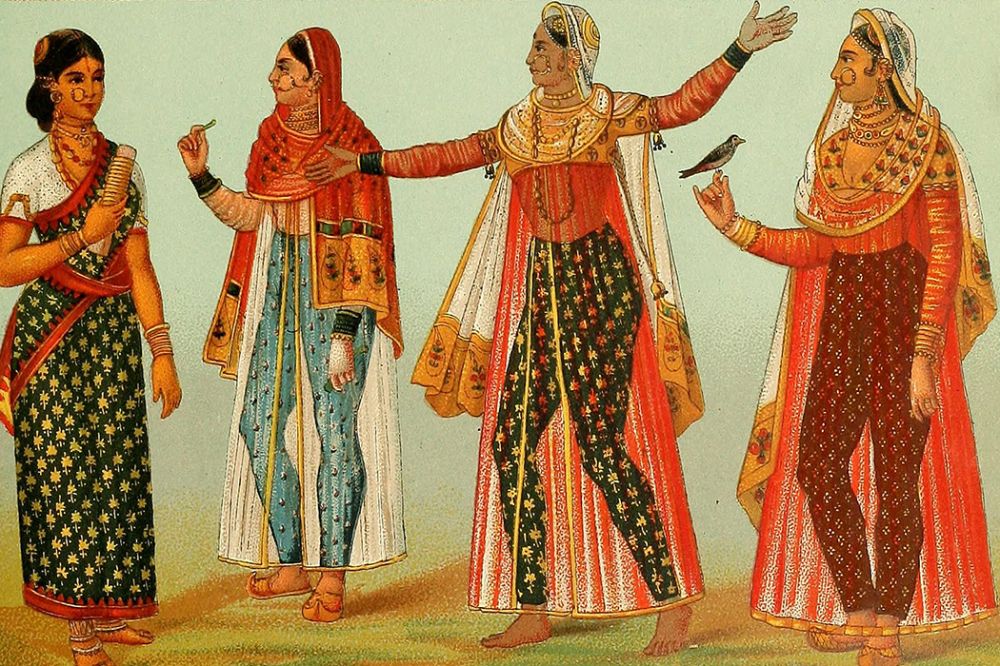
Introduction: India’s Fabric of Identity
“Textiles are the most eloquent witnesses of a culture.” — Textile History Journal (Crill, 1996).
Clothing in India is not mere cover; it is history woven in thread. To speak of India is to speak of textiles. From the faint impressions of woven cotton found in the ruins of Mohenjo-daro to the shimmering silks of today’s fashion weeks, clothing in the subcontinent has never been a mere matter of covering the body. It is a living archive of climate, technology, belief, and power—an art of survival and a declaration of identity. As historian Rosemary Crill observes in Textile History, “Textiles are the most eloquent witnesses of a culture,” carrying within their fibers the story of who wove them, who wore them, and the worlds through which they traveled.
Geography laid the first threads. India stretches from Himalayan snows to tropical coasts, and its varied climates demanded equally varied fabrics. The hot, dry plains of the northwest encouraged the early use of light, breathable cotton—one of humanity’s oldest cultivated fibers—while the humid northeast nurtured the golden muga silk unique to Assam. Archaeological finds from the third millennium BCE reveal cotton fragments, spindles, and dyed beads, confirming that the people of the Indus Valley were already skilled in spinning and color. These humble remains signal the beginning of a textile tradition that would one day clothe emperors and fuel global trade.
Yet environment alone does not explain India’s sartorial richness. Religion and philosophy gave clothing profound symbolic charge. Ancient Vedic texts speak of vastra (cloth) not only as a physical necessity but as a marker of ritual purity and social order. Later, Buddhist monastic codes specified the color and size of robes to embody ideals of detachment, while Jain ascetics chose the simplest of coverings—or none at all—to express renunciation. Each thread carried meaning; each drape became a conversation between the material and the metaphysical.
Trade then carried these meanings outward. By the first millennium BCE, Indian cottons and silks moved along maritime and overland routes to Mesopotamia, Rome, and China, prized for their softness and fast colors. Greek accounts marveled at “Indian cloth dyed with colors so fast they never fade,” an early recognition of the subcontinent’s mastery of natural dyes like indigo and madder. These exchanges did more than enrich foreign wardrobes; they introduced new weaving techniques and aesthetic preferences back into India, setting the stage for centuries of stylistic innovation.
Thus, the history of Indian clothing is not a linear tale but a densely woven fabric—its warp the enduring local traditions, its weft the countless contacts with distant worlds. To trace these threads is to watch a civilization dress itself in changing ideas of beauty, power, and belonging, century after century.
Origins in the Indus Valley
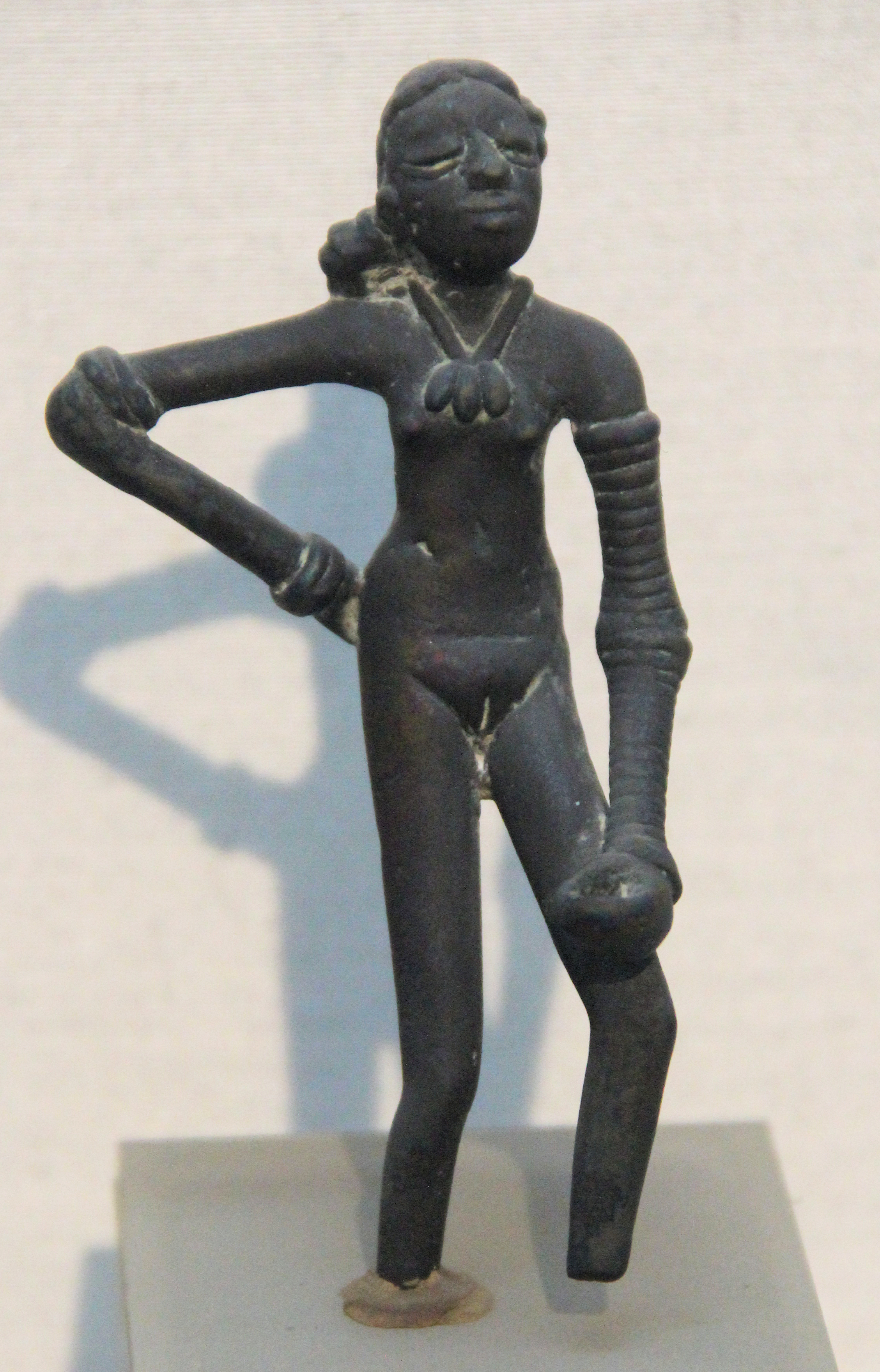
Any exploration of India’s clothing history begins more than 4,000 years ago in the brick-built cities of the Indus Valley Civilization (c. 2600–1900 BCE). Spread across present-day Pakistan and northwestern India, sites like Mohenjo-daro, Harappa, Dholavira, and Lothal reveal one of the world’s earliest urban cultures—and some of the first evidence of textile production anywhere.
Cotton, the subcontinent’s gift to the world
Archaeological excavations have uncovered spindle whorls, terracotta figurines, and minute fragments of cotton fiber, proving that the Harappans were spinning and weaving long before similar technologies appeared in much of the ancient world. At Mohenjo-daro, soil samples yielded traces of cotton so fine that early British excavators compared it to the celebrated muslin of Bengal. Historian J.M. Kenoyer notes in Ancient Cities of the Indus Valley Civilization that this is “the earliest direct evidence of cotton use,” predating Egyptian linen and Mesoamerican cotton cultivation by centuries. This mastery of cotton would later shape India’s global trade, but its roots lie in these Bronze Age looms.
Figurines and seals as fashion snapshots
Though textiles themselves rarely survive, the Indus people left behind a gallery of clay figurines, stone seals, and bronze statues that provide tantalizing glimpses of clothing styles. The celebrated “Dancing Girl” bronze from Mohenjo-daro, with her confident pose and armful of bangles, wears little more than a short skirt or perhaps a beaded belt—suggesting the use of minimal, body-hugging garments suited to a hot, semi-arid climate. Male statues often show a draped cloth over one shoulder and around the waist, resembling an early form of the dhoti or antariya. Intricate hairstyles and jewelry—headbands, fillets, and elaborate coiffures—signal that adornment and self-presentation were already central to Harappan life.
Colors and dyes
Excavations at sites like Lothal have produced evidence of dyestuffs, including madder (Rubia cordifolia), a plant still used for deep red hues in Indian textiles. Bead-making workshops discovered there indicate a sophisticated understanding of color, ornamentation, and trade. Scholars such as Marta Ameri (Journal of Archaeological Science, 2018) argue that these workshops functioned as hubs where dyes, beads, and textiles intersected in a vibrant craft economy.
Urban planning and clothing needs
The Indus cities were remarkable for their grid-like streets, drainage systems, and standardized brick sizes—features that speak to advanced social organization. Clothing, too, likely reflected this ordered civic life. The prevalence of standardized weights and measures suggests a regulated textile trade, with cotton and perhaps wool being spun in household or communal workshops. The cool interiors of multi-storied houses and the presence of public baths indicate that residents valued cleanliness, which in turn would have influenced the choice of easily washable fabrics.
Trade routes and external influences
The Indus people were not isolated. Seals found in Mesopotamian cities such as Ur bear Indus script, attesting to active trade across the Arabian Sea. Textiles were almost certainly among the goods exchanged. Cuneiform records mention “Sindhu cloth,” a term some scholars associate with fine cotton imports from the Indus region. Such early commercial networks laid the foundation for India’s later reputation as the “emporium of the world” in cotton and silk.
Legacy
Although the Harappan script remains undeciphered, the surviving material culture speaks eloquently. The Indus Valley gave the world its first known cotton textiles, pioneering techniques of spinning, dyeing, and weaving that would echo through millennia. When later Indian traditions—from the muslins of Bengal to the khadi of Gandhi—celebrate cotton as a symbol of identity and resilience, they unknowingly pay homage to these ancient spinners along the Indus.
Vedic and Mauryan Eras: Drapes and Dharma
If the Indus Valley introduced the subcontinent to cotton and urban weaving, the Vedic and Mauryan periods (c.1500–200 BCE) transformed cloth into a language of ritual, hierarchy, and expanding trade. In these centuries, the subcontinent moved from semi-nomadic pastoral societies to centralized empires, and clothing evolved in tandem with philosophy, statecraft, and economic growth.
Vedic Texts and the Semi-Stitched World
The Vedic corpus—Rigveda, Atharvaveda, and later the Brahmanas—offers some of the earliest descriptive vocabulary for clothing in South Asia. Words like vastra (cloth), antariya (lower garment), uttariya (upper drape), and paridhana (wraparound) recur in hymns and ritual manuals. These references reveal a wardrobe built around unstitched drapes, typically lengths of cotton or wool wound around the waist and over the shoulder. The simplicity of these garments reflected both the technology of the time (hand-woven fabrics best suited for wrapping) and the spiritual ideals of purity. Cloth was often left uncut because stitching was believed to trap impurities; smooth, unseamed drapes could be ritually purified with water and fire.
Men generally wore the dhoti-like antariya secured with a belt, while women favored a three-piece ensemble of lower cloth, chest band (stanapatta), and upper shawl. Dyeing techniques—madder for reds, turmeric for yellows, indigo for blues—added color symbolism: white for ritual purity, red for fertility, saffron for ascetics. As Indologist Roshen Dalal notes in The Vedas: An Introduction, the act of donning a fresh garment before sacrifice was itself an offering to the gods, underscoring the sacred role of clothing in maintaining cosmic order (ṛta).
Urban Refinement under the Mauryas
By the 4th century BCE, the rise of the Mauryan Empire under Chandragupta and Ashoka brought political unification and economic dynamism. Arthashastra texts and the Greek ambassador Megasthenes describe bustling markets for textiles in Pataliputra (modern Patna). Muslin from Bengal, prized for its almost transparent fineness, and wild silks from Assam and Orissa circulated widely. The state maintained weaving guilds and levied taxes on dyers and spinners, revealing an organized industry far removed from the village-level production of earlier centuries.
Courtly fashion reflected this prosperity. Reliefs on the sandstone pillars of Ashoka and the railings of Bharhut stupa depict men and women draped in elegantly pleated garments, often with decorative borders and elaborate girdles. Both sexes adorned themselves with jewelry—bead necklaces, armlets, and headdresses—that blurred the line between clothing and ornament. Greek observers were astonished by the lightness of Indian fabrics, with Megasthenes writing that “the garments of the Indians are so fine that they are scarcely visible.”
Dharma and Social Signifiers
Despite growing opulence, dress remained a marker of spiritual and social identity. Buddhist and Jain monastic codes, emerging during this period, prescribed robes of specific colors and simple construction to embody renunciation. Ashoka’s own edicts, inscribed on rock and pillar, speak of compassion and self-restraint—values that informed the plain saffron or ochre robes of monks. At the same time, the evolving caste system used textiles to signal status: higher castes favored unstitched white cotton for purity, while artisans and traders wore brighter hues and patterned cloth.
Continuities and Innovations
The Vedic and Mauryan eras thus crystallized two enduring features of Indian fashion. First, the aesthetic and ritual preference for draped garments—seen today in the sari, dhoti, and dupatta—has roots in the ancient belief that uncut cloth carries spiritual potency. Second, the Mauryan expansion of textile production and trade set the economic foundation for India’s later fame as a global textile powerhouse. The loom, once a household tool of subsistence, became a vehicle of empire, carrying Indian fabrics from the Bay of Bengal to the markets of West Asia and the Mediterranean.
In these centuries, cloth was far more than a necessity. It was prayer and policy, a soft but potent expression of dharma—the moral order that bound society and cosmos together. The folds of a dhoti or the pleats of a woman’s antariya were not merely fashion choices; they were visible affirmations of a civilization weaving spiritual meaning into everyday life.
Classical Textiles: Gupta to Early Medieval

Between the fourth and eighth centuries CE, India entered a period often called the Classical Age, marked by the political stability of the Gupta dynasty and a flowering of literature, art, and science. In the realm of clothing and textiles, this was an era of refinement and expansion. The Guptas inherited the Vedic love of draped garments but elevated them into a sophisticated courtly aesthetic, while powerful regional kingdoms—such as the Pallavas in the south and the Vakatakas in the Deccan—added new weaves, dyes, and decorative techniques to the subcontinent’s wardrobe.
Gupta Elegance: Muslins and Jewelled Drapes
The Guptas ruled much of northern India from the fourth to sixth centuries CE, presiding over a prosperous economy fueled by agriculture, trade, and thriving urban centers. Contemporary literary sources such as Kalidasa’s plays and the Kamasutra of Vatsyayana describe garments of “gossamer muslin” and “garlands of silk,” highlighting both the sensual appeal and technological finesse of Indian fabrics. Chinese pilgrim Fa-Hien, who visited during Chandragupta II’s reign, recorded his admiration for the “fine cotton cloth, light as mist,” produced in the Gangetic plains.
Sculptural evidence corroborates these texts. The murals of Ajanta and the stone carvings of Sanchi and Udayagiri depict men and women wrapped in diaphanous muslins and richly bordered silks. The basic components remained unstitched: the antariya (lower garment), uttariya (upper scarf), and stanapatta (breast band) for women; the dhoti-like drape and shawl for men. But the fabrics were now sheer, delicately pleated, and often edged with intricate borders of gold thread, suggesting advances in spinning and weaving. Decorative motifs—lotus scrolls, flying geese, geometric checks—echo the period’s sculptural and architectural patterns.
Technological Innovations and Trade
Gupta weavers perfected the art of producing ultrafine cotton muslin, especially in Bengal and the lower Ganges delta. Archaeobotanical studies, including those published in the Journal of Archaeological Science, identify high-quality Gossypium arboreum cotton varieties cultivated for soft, long-staple fiber. Indigo dyeing techniques reached new heights, creating deep blues that would later enchant Roman and Arab merchants.
Long-distance trade expanded dramatically. Gupta-period coins depict ships and trading scenes, reflecting vibrant maritime commerce with Southeast Asia. Indian textiles—cottons, silks, and dyed fabrics—were prized exports to the Roman Empire, Central Asia, and China. The Periplus of the Erythraean Sea, though slightly earlier, already mentions Indian cloth markets, and by the Gupta era these routes had become arteries of wealth. Textiles functioned as currency and diplomacy; bolts of muslin were exchanged as gifts to foreign envoys and Buddhist monasteries.
Regional Styles and Religious Patronage
While the Guptas dominated the north, southern polities like the Pallavas fostered their own textile traditions. Early references to Kanchipuram silk emerge in Tamil Sangam poetry, praising shimmering saris woven with gold zari. Buddhist monasteries in Andhra and Odisha became centers of dyeing and weaving, where monks required sturdy yet symbolic robes. Donations of cloth to monasteries—recorded in inscriptions from Sarnath to Amaravati—underscore the religious dimension of textile production. Cloth was merit-making: a gift that warmed both the body and the soul.
Transition to the Early Medieval
As Gupta authority waned after the sixth century, regional kingdoms took center stage, each contributing local flavors to India’s textile map. In Kashmir, the art of wool weaving and the famed pashmina began to flourish. In Rajasthan and Gujarat, resist-dyeing techniques such as bandhani emerged, creating tie-dyed patterns still celebrated today. The rise of temple-centered economies encouraged the production of ceremonial cloths for Hindu deities, linking weaving to the rhythms of devotional life.
Legacy of the Classical Age
The Gupta and early medieval periods crystallized a balance between luxurious refinement and enduring simplicity. Draped garments retained their spiritual resonance, but the fabrics became lighter, brighter, and technically more complex. Trade carried these innovations far beyond India’s borders, laying the groundwork for the global reputation Indian textiles would enjoy in the Islamic and Mughal eras. When later travelers spoke in awe of Bengal muslin “woven from air,” they were echoing a tradition whose roots reached back to this classical moment of elegance and innovation.
Islamic & Sultanate Influence: Weaves of Power and Refinement
“Textiles were the soft power of the Sultanate courts—spreading aesthetics more subtly than armies ever could,” observes art historian Rosemary Crill (2009, Indian Textiles).
The arrival of Islam in the Indian subcontinent from the 12th century onwards—marked by the Delhi Sultanate (1206–1526) and followed by regional sultanates—ushered in a transformative chapter in Indian clothing and textile traditions. This period was not merely a political shift; it was a profound cultural encounter that brought Persian aesthetics, Central Asian craftsmanship, and Middle Eastern sartorial ideals into dialogue with the vibrant indigenous styles of the subcontinent.

From Drapes to Stitched Silhouettes
Until the Sultanate period, Indian dress largely celebrated the art of draping: the sari for women, the dhoti for men, and unstitched garments like the uttariya and antariya. The Islamic world, however, had a long tradition of tailored clothing, shaped for mobility and modesty. The introduction of garments such as the jama (a long, flared tunic), pyjama (loose trousers), qabā (robe), and angarkha heralded a sartorial revolution. Men of the court adopted these stitched silhouettes, combining them with turbans and sashes, while women began to experiment with long tunics (peshwaz), veils (dupatta), and layered ensembles.
Textile historian Lotika Varadarajan (2004, Textiles of Medieval India) notes that this “stitching culture” represented more than mere fashion; it symbolized a new social hierarchy and courtly decorum. Clothing became a visual marker of affiliation with the Indo-Islamic elite, even as Hindu communities selectively adapted these influences to suit local customs.
The Aesthetic of Opulence
The Sultanate courts patronized textiles of extraordinary luxury. Silk weaving centers in Gujarat, Bengal, and the Deccan flourished, producing brocades, satin, and velvets embellished with gold and silver threads (zari). Persian motifs such as the boteh (paisley), arabesques, and intricate geometric patterns appeared alongside traditional Indian florals, creating a hybrid visual language.
The art of ikat, particularly in Gujarat’s Patan and Andhra’s Nalgonda, received royal support, while fine muslins of Bengal were exported to the Middle East through thriving trade routes. The Delhi Sultanate also introduced techniques like zardozi (gold embroidery) and badla (metallic yarn), elevating garments to shimmering status symbols.
Clothing and Cultural Negotiation
While Islamic rulers favored modesty—encouraging women to cover their heads and bodies—this did not translate into uniformity. Regional variations persisted. In the Deccan sultanates, for instance, women continued to wear sari-like drapes under long coats. In Gujarat and Rajasthan, Hindu nobility fused the jama with Rajput-style angarkhas and brightly dyed turbans. This interplay gave rise to what historian Emma Flatt calls “vernacular cosmopolitanism,” where the foreign and the local coexisted creatively (Journal of the Royal Asiatic Society, 2011).
Trade and Global Connections
The Sultanate period was also a time of intense maritime commerce. Indian textiles reached Cairo, Baghdad, and Constantinople, influencing Ottoman and Safavid fashions. The famed Coromandel coast cottons—lightweight, colorfast, and intricately patterned—were coveted in West Asia. In return, India imported luxury fabrics like taffeta and damask, which inspired indigenous weavers to experiment with sheen and texture.
Legacy for the Mughal Age
The Islamic and Sultanate sartorial innovations laid the groundwork for the Mughal empire’s legendary textile culture. Techniques like zardozi, gota work, and brocade weaving reached new heights under the Mughals but owed much to the foundations set by earlier sultanates. The mingling of Persian tailoring with Indian drapes also set the stage for garments like the sherwani, which would later become emblematic of Indo-Muslim nobility.
Mughal Splendour: Weaving an Imperial Aesthetic
“The Mughal court was a theatre of textiles” — Ebba Koch in Artibus Asiae.
If the Delhi Sultanate planted the seeds of Indo-Islamic sartorial culture, the Mughal Empire (1526–1857) brought it into full bloom. Under the patronage of emperors like Akbar, Jahangir, Shah Jahan, and Aurangzeb, Indian textiles entered a golden age that dazzled both domestic elites and global markets. The Mughal court did not merely adopt clothing as a sign of wealth; it transformed fabric into a language of power, diplomacy, and art.

Imperial Patronage and Textile Innovation
The Mughal atelier was a hub of experimentation where Persian refinement met Indian ingenuity. Emperors sponsored royal karkhanas (workshops) in centers such as Agra, Lahore, Ahmedabad, and Burhanpur, producing silks, brocades, muslins, and carpets of unprecedented quality.
Abu’l Fazl’s Ain-i-Akbari—a detailed record of Akbar’s administration—lists dozens of textile varieties, from the gossamer-thin mulmul khās of Dhaka to the shimmering kimkhab brocades of Banaras.
Textile historian Rosemary Crill (2009, Indian Textiles) notes that Mughal fabrics represented “the marriage of natural brilliance with technical perfection.” Innovations included jamdani weaving, where delicate motifs were inserted by hand into the loom, and pashmina shawls from Kashmir, prized for their unparalleled softness and warmth.
Fashioning the Mughal Court
“The Mughal textile industry was not just an economy; it was an empire of taste,” writes textile scholar Pramod Chandra (1983, Studies in Mughal Art and Architecture). “Its weavers clothed not only bodies but imaginations, from Agra to Amsterdam.”
Mughal fashion was a careful orchestration of elegance and symbolism. Men typically wore the jama, a long robe tied to the side, paired with paijama trousers and richly embroidered sashes (patka). Women favored the peshwaz (long gown), odhni (veil), and churidar (tight trousers). Colors and patterns conveyed status—royal garments often featured gold zari work, floral motifs, and the imperial emblem of the sun.
Court paintings from the time reveal an aesthetic of subtle layering: translucent muslins over jewel-toned silks, turban jewels reflecting sunlight, and carefully arranged folds that highlighted the mastery of the tailor and weaver alike. Jahangir, known for his love of flowers and naturalism, encouraged patterns inspired by tulips, irises, and roses, reflecting a broader Mughal passion for gardens and paradise symbolism.
Global Demand: The World Covets Indian Cloth
Perhaps no era before or since witnessed such international admiration for Indian textiles. Fine muslins from Bengal—so light they were poetically described as “woven air”—became a sensation in Ottoman Turkey, Safavid Iran, and eventually Europe. The East India Companies of Britain, the Netherlands, and France competed fiercely to secure contracts for chintz, calico, and silk, fueling the first global fashion economy.
By the 17th century, Indian fabrics were not only dressing Asian courts but also influencing European tastes. Painted and resist-dyed chintz inspired new trends in France and England, eventually leading to protective tariffs designed to curb Indian imports—a testament to their overwhelming popularity.
Science and Symbolism
Mughal textile excellence rested on scientific precision. Natural dyes—indigo, madder, lac, and saffron—produced colors of remarkable fastness. Weavers mastered complex techniques like ikat, bandhani tie-dye, and block printing with mordants and resists. As noted in the Journal of Textile History (2014), Mughal weavers combined empirical observation with inherited craft knowledge, creating fabrics that were both technically sophisticated and aesthetically arresting.
Continuity and Legacy
Even after the decline of Mughal political power, their textile traditions endured. Banarasi brocades, Kashmiri shawls, and Dhaka jamdanis continued to define Indian luxury well into the colonial period and remain coveted today. Modern Indian bridal wear—laden with zari, intricate embroidery, and Mughal floral motifs—still echoes this imperial grandeur.
Colonial Disruptions and Swadeshi Movements: Cotton, Calico, and the Politics of Cloth
“Khadi was not just cloth; it was the livery of freedom.” — M.K. Gandhi.
The 18th century marked a dramatic turning point in India’s clothing and textile history. As the Mughal empire fragmented, European trading companies—especially the British East India Company—tightened their grip on ports and production centers. What began as commerce soon became colonial rule, and with it came profound changes in how Indians made, wore, and imagined their clothing.
The Battle for Cotton: Calico Craze and Industrial Disruption
Indian cotton had captivated Europe for centuries. Painted and printed calicoes from Coromandel, fine muslins from Dhaka, and block-printed chintz from Gujarat were so popular in England and France that local weavers petitioned their governments for protection. By the early 18th century, Britain imposed Calico Acts (1700 & 1721) banning the import of finished Indian cottons to safeguard its own textile industry.
Yet even as bans were enacted, British merchants continued to profit by exporting raw Indian cotton to fuel the mills of Lancashire. Textile historian Giorgio Riello (Cotton: The Fabric that Made the Modern World, 2013) calls this “the great divergence of cloth”—India shifted from being the world’s premier textile exporter to a supplier of raw fiber for European factories.
New Fabrics, New Forms
Colonial contact brought new fibers and silhouettes into Indian wardrobes. Machine-spun yarn, mill-made longcloth, and European tailoring techniques gradually entered elite and urban dress. The blouse and petticoat, now integral to the sari, became widespread in the late 19th century as Victorian ideas of modesty influenced colonial society. Men in cities began wearing shirts, trousers, and frock coats, blending Western cuts with Indian fabrics.
Photography from the mid-19th century—such as the albums of Samuel Bourne—captures this hybrid style: Bengali babus in starched dhotis and English jackets, Parsi women in sari-like gara embroidery with lace borders, and Bombay mill owners in three-piece suits with silk turbans.
Khadi and the Politics of Resistance
Historian Sumathi Ramaswamy (2010) aptly observes:
“In colonial India, clothing was never just clothing. It was a battlefield where economics, ethics, and aesthetics collided.”

Cloth became a powerful weapon in India’s freedom struggle. Mahatma Gandhi’s call for swadeshi and the revival of hand-spun khadi in the 1920s turned spinning wheels into symbols of self-reliance. Gandhi urged Indians to boycott British textiles and wear homespun cotton to undermine colonial economic power.
“Khadi is not just a piece of cloth,” Gandhi declared in 1925, “it is the symbol of unity of Indian humanity.” Wearing khadi became a political act, uniting peasants and elites in a shared sartorial statement of resistance.
Urban Fashion and Early Modern Designers
By the early 20th century, Indian cities like Bombay, Calcutta, and Madras witnessed the rise of department stores, fashion magazines, and tailoring schools. Elite women experimented with sari drapes such as the modern nivi style popularized by Jnanadanandini Devi of the Tagore family, which allowed freer movement in public. Men’s fashion evolved through Nehru jackets, a streamlined descendant of the Mughal achkan fused with Western tailoring.
Academic studies (e.g., Tulasi Srinivas, South Asian Popular Culture, 2010) show how these hybrid garments reflected a “negotiated modernity,” signaling both cosmopolitan aspirations and nationalist pride.
Scientific and Economic Dimensions
Colonial economic policies decimated traditional weaving centers like Dhaka, where the once-legendary muslin industry collapsed under competition from cheap Manchester cloth. Yet scientific interest in dyes and fibers also grew. British chemists studied natural dyes—indigo, madder, lac—while Indian artisans adapted to synthetic anilines introduced in the late 19th century, altering the color palette of saris and turbans.
Legacy in Contemporary Fashion
The colonial period left an ambivalent legacy. On one hand, it crippled India’s traditional textile economy; on the other, it laid the groundwork for modern Indian fashion. The fusion of Western silhouettes with Indian fabrics created new styles that designers like Ritu Kumar, Sabyasachi Mukherjee, and Abraham & Thakore continue to reinterpret. Today’s khadi revival and organic cotton movements owe much to the nationalist fabric politics of the early 20th century.
Regional Traditions and Living Heritage: Threads that Bind a Nation
“Every sari carries the memory of the hand that wove it,” notes sociologist Bina Agarwal (Economic and Political Weekly, 2018). “To wear one is to wear a fragment of living history.”
Even after centuries of imperial courts, colonial disruption, and global fashion cycles, India’s most enduring strength lies in its regional diversity. From the high plateaus of Ladakh to the coastal plains of Kerala, each community has preserved textile traditions that are at once practical, symbolic, and aesthetically unique. These living practices offer a counterpoint to the narrative of homogenization, reminding us that Indian fashion is not a single story but a kaleidoscope of identities.
The Weavers of the North

The northern plains and Himalayan foothills have long been home to some of the subcontinent’s most celebrated weaves.
-
Kashmir’s pashmina shawls, painstakingly hand-spun from the under-fleece of Changthangi goats, embody a legacy of luxury dating back to the Mughal courts. A single fine shawl could take months to weave, and motifs such as the buta (paisley) symbolize fertility and eternity.
-
In Uttar Pradesh, Banarasi brocades continue to shimmer with gold and silver zari threads. Worn in weddings across India, these saris trace their lineage to Mughal karkhanas and remain coveted heirlooms.
-
Himachali and Ladakhi communities maintain traditions of woolen robes (gonchas, chupas) that reflect Tibetan influences and suit the high-altitude climate.
Western India: Bandhani and Patola

Gujarat and Rajasthan sparkle with color and resist-dye ingenuity.
-
Bandhani, the intricate tie-dye technique, creates thousands of tiny dots by plucking and binding fabric before dyeing, resulting in swirling patterns that have adorned turbans, odhnis, and saris for centuries.
-
Patola from Patan represents the double-ikat technique, where both warp and weft threads are tie-dyed before weaving—a mathematically complex process that can take a year to complete a single sari.
-
The Kutch embroidery tradition, with its mirror work and bold stitching, turns everyday garments into living canvases.
Scholars such as Lotika Varadarajan (Indian Journal of Traditional Knowledge, 2007) emphasize that these crafts are more than decorative—they encode social status, marital rites, and even community cosmology.
Eastern Looms: Bengal to Odisha

The eastern states have nurtured traditions renowned for their softness and symbolism.
-
Jamdani muslin of Bengal, once described by Mughal chroniclers as “woven air,” remains a UNESCO-recognized heritage. Motifs like the lotus and mango reflect both Hindu and Islamic iconography.
-
Odisha’s Sambalpuri ikat features bold temple borders and curvilinear motifs, often linked to local myths and rituals.
-
Assam’s Muga silk, golden-hued and naturally glossy, is unique to the Brahmaputra valley and still worn for weddings and religious festivals.
Southern Legacies: Silk, Gold, and Temple Culture

South India’s textile landscape thrives on silk and devotion.
-
Kanchipuram silk saris from Tamil Nadu, woven with contrasting borders and rich gold zari, are prized for their durability and ceremonial grandeur.
-
Kerala’s Kasavu mundu, with its understated white cotton and gold border, exemplifies a minimalist elegance tied to the festival of Onam.
-
Karnataka’s Ilkal saris and Andhra Pradesh’s Venkatagiri cottons reflect centuries of trade along the Deccan routes.
Anthropologist Vijaya Ramaswamy (Textile History, 2015) observes that temple patronage historically supported these weaving centers, linking textile production to religious economies and seasonal rituals.
North-East: A Mosaic of Identity

The North-Eastern states preserve some of India’s most vibrant and under-studied sartorial traditions.
-
In Nagaland, each tribe’s shawl carries specific color codes and motifs denoting clan, status, and even warrior achievements.
-
Arunachal’s Adi and Apatani communities use handwoven skirts and jackets that incorporate natural dyes and bamboo fibers.
-
Manipur’s moirangphee and phanek combine bright stripes with ancient loom techniques, while Assam’s mekhela chador remains a versatile garment worn by all generations.
These textiles are not mere ornaments but living archives of oral history, with designs passed from mother to daughter as part of community identity.
Living Heritage and Contemporary Revival
Despite challenges from mechanization and global fast fashion, many of these traditions are experiencing revival through Geographical Indication (GI) tags, government initiatives, and grassroots design movements. Banarasi brocades, Kanchipuram silks, Pochampally ikat, and Kashmiri pashmina all enjoy GI protection, helping artisans secure fair prices and safeguard authenticity.
Designer collectives and ethical fashion brands now collaborate directly with weavers, blending traditional techniques with modern aesthetics to reach new markets.
Post-Independence to Contemporary Fashion: Global Runways, Local Roots
India’s independence in 1947 marked not only a political rebirth but also a reimagining of national identity through clothing. Freed from colonial economic control, Indian designers, artisans, and everyday citizens began negotiating a new relationship with their sartorial heritage—balancing tradition with the aspirations of a modern, globalizing nation.
Nation-Building Through Fabric
In the years immediately following independence, khadi retained its status as the moral fabric of the republic. Political leaders such as Jawaharlal Nehru and Sarojini Naidu continued to wear khadi as a symbol of self-reliance and democratic values. Nehru’s own tailored achkan-style jacket, streamlined and collarless, became an international fashion statement when worn by The Beatles and other Western icons in the 1960s.
State-run cooperatives and government bodies such as the All India Handloom Board were established to revive and protect traditional weaves. The Five-Year Plans prioritized rural handloom sectors, enabling continued production of Banarasi brocades, Kanchipuram silks, and Assamese muga despite the rapid mechanization of India’s textile mills.
Bollywood and Mass Appeal
As India’s film industry gained global reach, Bollywood became a key driver of fashion trends. From Madhubala’s flowing anarkalis in the 1950s to Zeenat Aman’s bell-bottoms in the 1970s and Deepika Padukone’s designer lehengas today, the silver screen has continually shaped popular taste. Costume designers like Bhanu Athaiya (India’s first Oscar winner) turned regional styles into aspirational looks, while actors like Rekha made the Kanjeevaram sari synonymous with glamour.
The Birth of Indian Fashion Designers
The 1980s and 1990s saw the rise of India’s first generation of fashion designers who presented Indian textiles in contemporary silhouettes. Names such as Ritu Kumar, Rohit Bal, and Tarun Tahiliani brought Indian craftsmanship to international runways. They experimented with fusion wear—combining Western cuts with traditional embroidery, block prints, and handloom fabrics—laying the foundation for a vibrant Indian fashion industry.
The establishment of the National Institute of Fashion Technology (NIFT) in 1986 professionalized design education and created a pipeline for new talent. Designers like Sabyasachi Mukherjee later popularized “vintage India” aesthetics with opulent bridal wear that blends Mughal motifs, Banarasi brocades, and hand-embroidered zardozi.
Liberalization and Global Reach
India’s economic liberalization in the 1990s opened the floodgates to global brands and fast fashion. International labels such as Levi’s, Zara, and H&M found eager customers in India’s expanding middle class. Yet rather than erasing tradition, globalization spurred renewed interest in heritage. Luxury designers began collaborating with artisans to market handloom fabrics as eco-friendly, slow fashion.
Export statistics reflect this dual movement: while India remains one of the world’s largest producers of cotton and ready-to-wear garments, niche sectors like organic khadi, handwoven ikat, and Pashmina are experiencing global demand. Studies in the Journal of Fashion Marketing and Management (2021) show a growing consumer preference for “authentic heritage products” among millennials.
Digital Age and Sustainable Fashion
Social media has democratized style, allowing young designers and independent weavers to showcase their work directly to global audiences. Instagram campaigns like #IWearHandloom have reignited interest in regional crafts, while start-ups such as Raw Mango and Anita Dongre’s Grassroot emphasize sustainability and fair trade.
The push for sustainable fashion resonates with India’s traditional emphasis on natural fibers and longevity. Organic cotton movements, plant-based dyes, and upcycled saris reflect a philosophy that values circularity over consumption, echoing centuries-old Indian practices of reusing and repurposing fabric.
Conclusion: Clothing the Continuum of Indian Identity

“Textiles in India are at once utilitarian and symbolic, a language of status and belief.” — Journal of Material Culture.
From the finely woven muslins of the Indus Valley to the embroidered lehengas of modern bridal couture, the history of clothing in India is a story of continuity and reinvention. Each era—Vedic sages in unstitched garments, Mughal emperors draped in brocades, colonial patriots spinning khadi, contemporary designers blending heritage with high fashion—has added a new layer to the nation’s fabric of identity.
Despite centuries of political upheaval and global trade, Indian dress has never been static. Instead, it thrives on adaptation: ancient drapes coexist with denim; temple silks share runways with avant-garde streetwear. As fashion scholar Neha Vermani writes in Textile History (2022), “India’s clothing traditions resist linear narratives. They are not fossils of the past but living organisms that breathe with the present.”
This living heritage invites us to look beyond mere trends. Each sari, shawl, or kurta carries the memory of the hands that spun, dyed, and wove it—a silent dialogue between the past and the future. Whether one wears khadi to honor Gandhi’s call for self-reliance or a Banarasi brocade to celebrate a wedding, Indian clothing remains what it has always been: an art form, an economy, and a declaration of identity.
References
-
Crill, R. (1996). “Indian Textiles: Trade and Production.” Textile History, 27(2), 103–120.
-
Kenoyer, J. M. (1998). Ancient Cities of the Indus Valley Civilization. Oxford.
-
Kumar, R. (2005). “Costume and Textiles under the Delhi Sultanate.” Indian Historical Review, 32(1).
-
Roy, T. (2010). The Economic History of India 1857–1947. Oxford University Press.
-
Bose, M. (2018). “The Sari and National Identity in Postcolonial India.” Fashion Theory, 22(4).

Please send your valuable feedback