
“Water is life’s matter and matrix, mother and medium. There is no life without water.” — Albert Szent-Györgyi, Nobel Laureate
Water has always been India’s quiet architect. Long before dams and motorised pumps, communities crafted infrastructures that were local, layered, and astonishingly sophisticated: subterranean stepwells (baoli/vav), sprawling tanks (eri, oorani, cheruvu, kere), and life-giving canals that threaded floodplains to fields. These weren’t just hydraulic devices; they were social spaces, ritual theatres, micro-climate machines, and engines of agrarian prosperity.
This essay journeys across time—from Indus cities to medieval sultanates and colonial canal empires—to piece together India’s water histories and the lessons they hold for a warming, thirsty century.
Deep Time Origins: Harappan Reservoirs & Urban Water Design
“The Harappans were the pioneers of water management, creating urban drainage and reservoirs that surpassed their time.” — D.P. Agrawal, The Indus Civilization: An Interdisciplinary Perspective

Archaeology shows that water management sat at the core of Indus urbanism. Dholavira (Kachchh, Gujarat) is exemplary: an acropolis and lower town framed by multi-reservoir systems, channels, and sluices that captured monsoon and flash-flood flows from seasonal streams. High-resolution surveys and excavation syntheses describe a network of massive cut-stone reservoirs with regulating features—evidence of design thinking that integrated hydrology, architecture, and civic life. (HESS, asc.iitgn.ac.in)
UNESCO’s inscription notes Dholavira’s fortifications, gateways, ceremonial ground, and—crucially—its water reservoirs as part of the city plan. Unlike many other Harappan sites, Dholavira lies in the arid Rann of Kachchh, where rainfall is scarce and seasonal rivers run dry for most of the year. To thrive in such a challenging environment, its inhabitants engineered an intricate network of water reservoirs—cut from solid rock and lined with stone masonry—which were placed both within and around the fortified settlement, making water collection and storage a central aspect of civic design rather than a peripheral utility and also bear testimony of early human ingenuity in sustainable water management—a lesson that remains strikingly relevant in today’s age of water scarcity. (UNESCO World Heritage Centre)
Taken together, these findings challenge the idea that ancient water systems were rudimentary. They were precise, modular, and tuned to place. As one synthesis on ancient Indian hydrology puts it, classical texts and archaeological finds together show a long tradition of hydraulic knowledge and nature-based solutions. (HESS)
Why it matters today:
Dholavira illustrates resilient design principles—staggered storage, gravity-fed distribution, overflow safety, and material durability—that modern water planners are rediscovering in climate adaptation projects.
Stepwells: Architecture that Cools, Stores, and Brings People Together
“Stepwells were not merely utilitarian structures; they were also places of gathering, storytelling, and worship.” — Jutta Jain-Neubauer, The Stepwells of Gujarat
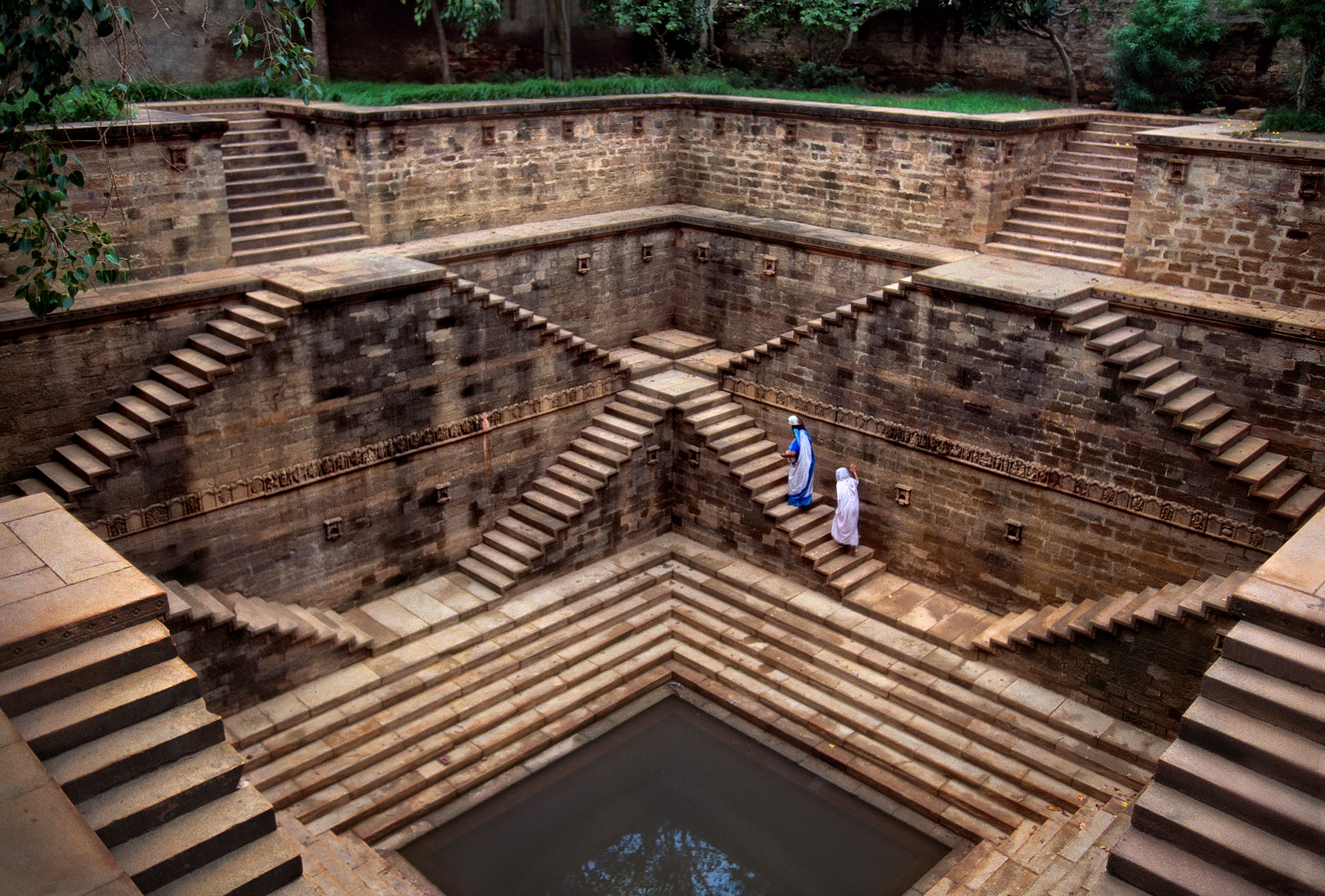
If reservoirs were city-scale sponges, stepwells were intimate, walk-down aquifers. From Gujarat and Rajasthan to Delhi and the Deccan, stepwells (vav/baoli/bavadi) evolved from simple pits to multi-storey, carved corridors descending to the water table. UNESCO calls stepwells a “distinctive form of subterranean water resource and storage system” on the subcontinent. (UNESCO World Heritage Centre)
How stepwells worked
- Vertical access to groundwater via flights of steps meant year-round availability, even as levels fluctuated seasonally.
- Thick masonry envelopes and sunken courts created cool microclimates; new engineering studies quantify the passive cooling effects. (ScienceDirect)
- Drainage, filters, and check-steps slowed and clarified inflow during rains; in many, small galleries and channels regulated seepage from adjacent aquifers. A recent review in Water consolidates engineering, architectural, and heritage perspectives across major stepwells in India. (MDPI)
The social life of water
Stepwells doubled as commons. Shade, airflow, and the presence of water turned them into everyday social spaces—markets, rest stops, and ritual precincts. Recent heritage scholarship frames them as living cultural landscapes, not inert monuments. (isvshome.com)
UNESCO describes stepwells as a “distinctive form of subterranean water resource and storage system”, and few monuments embody this idea as vividly as Rani-ki-Vav in Patan, Gujarat. Unlike surface-level tanks or reservoirs, stepwells were ingeniously constructed by excavating deep into the earth to reach the groundwater table, then carefully lining the shaft with stone to prevent collapse. This subterranean design not only ensured protection of water from evaporation in Gujarat’s arid climate, but also created a cool, shaded environment where people could gather, rest, and perform rituals.
Case notes: Rani-ki-Vav, Adalaj & Firoz Shah Kotla baoli
“Every baoli (stepwell) carries stories of survival in arid landscapes—an architectural dialogue between scarcity and abundance.” — Morna Livingston, Steps to Water
- Rani-ki-Vav (Patan, Gujarat): An 11th-century “functional inverted temple,” renowned for its sculptural program and spatial drama; UNESCO recognises it as an outstanding example of the stepwell tradition. It was built by by Queen Udayamati in memory of her husband King Bhima I of the Solanki dynasty. Rani-ki-Vav, in particular, demonstrates how ancient Indian communities integrated practical needs—securing water in semi-arid lands—with profound symbolic meanings, making water not only essential for survival but also central to cosmology, aesthetics, and community life. (UNESCO World Heritage Centre)

- Adalaj ni Vav (Gandhinagar district): It stands as one of the most celebrated examples of Gujarat’s stepwell tradition, often studied for its fusion of structural ingenuity and cultural motifs. Built in the late 15th century under the patronage of Queen Rudabai, it is not merely a utilitarian structure but a space where engineering precision and aesthetic ambition converge. The five-storied vav descends deep into the earth, supported by intricately carved stone columns and beams that ensure stability while also allowing shafts of sunlight and cool breezes to penetrate. Studies read its architecture as a fusion of structural ingenuity and cultural motifs, spotlighting both material conservation and urban context. (Athens Journals)

- In contrast, the Delhi stepwells—such as the Firoz Shah Kotla baoli—were often embedded within fortified complexes, linking water management with imperial power and leisure. The Kotla baoli, built in the 14th century during the reign of Firoz Shah Tughlaq, was not just a reservoir but also a summer retreat for the Sultan and his court. Enclosed within high stone walls, its shaded, cool interiors provided respite from Delhi’s scorching summers while ensuring a stable water source for the fort’s inhabitants.
Planning documents and city studies, including those prepared by the Delhi Urban Art Commission, emphasize how baolis like Kotla were integral to the urban morphology of Delhi, influencing both settlement density and landscape design. They demonstrate how water infrastructure was tied to imperial vision: baolis symbolized power, order, and control over natural resources in a way that was both functional and symbolic. Unlike the open, community-oriented stepwells of Gujarat, Delhi’s baolis often carried the imprint of royal exclusivity, even as they quietly supported everyday urban life. (Delhi Urban Art Commission)

Modern relevance:
Beyond heritage value, stepwells illustrate passive cooling, groundwater recharge through infiltration surfaces, and social co-benefits—ideas central to contemporary blue-green infrastructure.
Tanks: Community Reservoirs that Fed Agrarian Civilisations
“Tanks in South India were ecological microcosms—sustaining not only agriculture but also diverse flora, fauna, and village life.” — David Mosse, The Rule of Water

Across Peninsular India, tanks—lakes and ponds engineered with earthen bunds, surplus weirs, and channels—underpinned paddy agriculture and social life. Known variously as eri (Tamil), oorani (Tamil), cheruvu (Telugu), kere (Kannada), bundhs/johads (northwest), and ahars-pynes (Bihar), these systems operated as cascades, passing overflow from upstream to downstream, recharging wells and stabilising micro-climates.
Governance as technology
Anthropologist David Mosse famously argued that Tamil tank systems were not merely hydraulic but social institutions—a “public domain” through which village order was negotiated. His work shows how colonial and contemporary development schemes often misread or re-engineered tanks by abstracting them from those social worlds. (Wiley Online Library, Cambridge University Press & Assessment, JSTOR)
Why tanks worked (and why some faltered)
- Hydrological logic: Spreading storage across many nodes lowers evaporation losses relative to a single big reservoir, reduces flood peaks, and increases groundwater recharge.
- Maintenance ecology: Silt needed to be desilted and spread on fields (a nutrient loop). Social arrangements—labour obligations, rights, and rituals—kept this cycle alive.
- Disruption: Changes in land tenure, shifts to deep-bore wells, encroachments, and top-down schemes weakened those institutions, leaving tanks silted, polluted, or severed from catchments. Mosse’s analyses remain vital in understanding where repair must be ecological and social. (Cambridge University Press & Assessment)
Contemporary echoes:
Recent policy and research in heritage-water intersections argue for protecting ancient tank traditions—from Indus prototypes to medieval cascades—as living assets in a drought-and-deluge climate. (Frontiers)
Canals: From Early Diversions to the Colonial Canal Age
Kallanai (Grand Anicut): Oldest working diversion in the world?
“The Grand Anicut (Kallanai), built by Karikala Chola, continues to irrigate millions of acres—an engineering marvel still in use after nearly two millennia.” — R. Balasubramanian, Current Science Journal

On the Kaveri in today’s Tamil Nadu, the Kallanai (Grand Anicut)—traditionally dated to the early centuries CE and associated with the Chola ruler Karikala—is a low, broad stone masonry weir that diverts flows across the delta through canals. Environmental science and civil-engineering sources repeatedly describe it as one of the oldest water-regulating structures still in use, and as the hydraulic anchor of the Thanjavur rice country. (Frontiers, thecivilengineer.org, Granthaalayah Publication)
Its genius is its simplicity: a rockfill-masonry barrier sitting low in the river, feeding a network that spreads risk, silt, and fertility. Modern upgrades followed, but the basic geometry persists—a 1,800-year conversation between river and field.
The Upper Ganga Canal: Industrial-era gigantism
“The Ganga Canal was one of the most ambitious hydraulic projects of colonial India, combining traditional knowledge with modern engineering.” — Ian Stone, Canal Irrigation in British India: Perspectives on Technological Change in a Peasant Economy

In the mid-19th century, the Upper Ganga Canal and later the Lower Ganga Canal transformed the Ganga-Yamuna Doab into a regimented hydraulic machine. Scholarship on river health notes that since the 1850s these canals diverted substantial flows, reshaping ecology and economy. As one synthesis puts it, “every change in flow regime of a river is associated with some form of compromise of the integrity of the ecosystem.” (Frontiers)
Histories of the Ganga Canal trace engineering vision (Proby Cautley), political ambition, and the re-territorialisation of water. (liverpooluniversitypress.co.uk, pahar.in)
Western Yamuna Canal: Pre-modern roots, modern revivals

The Western Yamuna (Jamuna) Canal has medieval-Mughal antecedents and colonial remodelling. It was constructed in 1335 A.D during Feroj Shah Tughlaq’s rule but it ceased to flow in 1750 due to execessive siltation. Government of India appointed Mr G.R. Blane, an engineer of Bengal Engineers in 1817 to restore old Mughal canal. The canal was desilted and renovated during a period of 3 years. There was no permannet headworks constructed on river Yamuna. The supplies in canal rose and fell with the seasonal variation in the flow of river.
The famine of 1832-33 led to remodelling of the canal and constrcution of weir on Yamuna at Tajewala and a low masonry dam at Dadupur and Somb torrents about 19.2 km downstream of Tajewala were constructed during 1875-79. The sirsa branch, the largest of the branch canals of Western Jamuna Canal was constrcuetd during 1889-1895. The system was extensively remodelled and extended during 1940-43; modern water-policy research points to repeated rehabilitation cycles and its role in supplying irrigation and urban water in northern India. (IWA Publishing, Research Review)
Takeaway:
If tanks exemplify decentralised resilience, colonial canals exemplify scale and control—highly productive but ecologically consequential. Both are part of India’s water palimpsest.
How These Systems Engineered Climate Before “Climate Engineering”
“Thousands have lived without love, not one without water.” — W.H. Auden
Cooling cities, tempering drought
- Stepwells created cool microclimates—today measurable through temperature and airflow studies—offering lessons for heat-prone cities seeking passive cooling. (ScienceDirect)
- Tank cascades buffered monsoon variability, recharged aquifers, and reduced fluvial flashiness at catchment scale—virtues now sought via managed aquifer recharge and urban sponge design. (Cambridge University Press & Assessment)
Distributed risk
Plural infrastructures—wells, tanks, anicuts, canals—share water risk across scales. Dholavira’s modularity already hinted at risk distribution through multiple basins and regulators. (HESS)
Social contracts
Where maintenance, rights, and rituals were embedded in local communities, the O&M problem (operation and maintenance) largely solved itself. When those social contracts frayed, the hydraulics followed suit. (Cambridge University Press & Assessment)
Stories from the Ground: Four Walk-throughs
- Rani-ki-Vav, Patan
Walk down seven terraces: as daylight thins and air cools, sculptures bloom around you—avatars, goddesses, everyday women. Water sits at the axis mundi, sanctified and practical at once. UNESCO calls it “an inverted temple,” and the metaphor clicks instantly. (UNESCO World Heritage Centre) - Adalaj Stepwell, near Ahmedabad
You trace Arabic and floral motifs alongside Hindu imagery. The stair landings act as pauses in a carefully ventilated microclimate, a design the Athens Journal study reads for both craft and functional intent. (Athens Journals) - Firoz Shah Kotla Baoli, Delhi
Inside a Tughluq fort, the baoli’s circularity and rooms speak of retreat and regulation—architecture as comfort technology for a scorching city. Planning notes place it within a fortified urban ecology. (Delhi Urban Art Commission) - Kallanai, on the Kaveri
Stand on the river’s flank and feel the weir’s gentle push, old as empire and still doing quiet work—deflecting, distributing, fertilising. Engineering and environmental histories converge on its antiquity and continuity. (Frontiers, thecivilengineer.org)
What Went Wrong—and What Can Still Go Right
Disruptions
- Canal gigantism and borewell capitalism altered groundwater and river regimes. Colonial and post-colonial policies often prioritised command and control over local ecologies. (Frontiers)
- Institutional erosion: As Mosse shows, tank maintenance is as much social as hydraulic; when commons governance weakens, silt and encroachment take over. (Cambridge University Press & Assessment)
Recoveries & hybrids
- Stepwell conservation is expanding, but needs to move from monument care to hydrological revival—restoring catchments, percolation, and controlled recharge. Engineering reviews and heritage papers now argue for quantifying thermal and hydrological benefits in urban plans. (ScienceDirect, MDPI)
- Tank rejuvenation works when it repairs institutions (rights, desilting cycles) alongside embankments. Mosse’s caution against ahistorical “community management” templates remains instructive. (Cambridge University Press & Assessment)
- Canal modernisation can incorporate environmental flows, fish passages, and conjunctive use—pairing canal delivery with aquifer recharge instead of aquifer depletion. Critical canal histories of the Ganga and Yamuna systems are helping frame these redesigns. (Frontiers, IWA Publishing)
Practical Lessons for Water-Stressed Regions
“Every change in flow regime of a river is associated with some compromise of ecosystem integrity.” —Kaushal et al., Frontiers in Environmental Science (2019). (Frontiers)
- Design for diversity: Mix storage scales—household tanks + neighbourhood stepwell-like recharge shafts + city lakes—to avoid single-point failure.
- Plan for heat: Use subterranean, shaded, high-thermal-mass elements (the stepwell lesson) in public spaces. Quantify expected temperature drops using CFD or field measurements, as recent studies have started doing. (ScienceDirect)
- Conjunctive water use: Pair canal flows with managed aquifer recharge via tanks and flood-spreading grounds to cut evaporation and build drought insurance.
- Governance matters: Budget for maintenance rituals—annual desilting, sluice checks, vegetation management—and create commons institutions with real rights and duties (water turns, silt shares). (Cambridge University Press & Assessment)
- Measure environmental flows: In canal basins, keep minimum ecological flows in rivers; research on the Ganga links regime changes to ecosystem trade-offs, a reminder to design with the river, not against it. (Frontiers)
Thus, India’s water heritage isn’t a museum of dead technologies. It’s a toolbox. Stepwells show how to cool cities and recharge aquifers with beauty. Tanks teach us how to spread risk and bind communities to maintenance ecologies. Canals remind us of scale’s gifts and costs—and of designing with rivers’ right to flow.
If we read these water histories as engineering manuals and social charters, the proverb becomes policy: jal hai to kal hai—there is a tomorrow, if we keep faith with water.
Frequently Asked Questions (for readers)
Q1. Were stepwells only for water storage?
No. They were multi-functional: storage, access to groundwater, places of rest and ritual, and passive cooling courts in hot, dry climates. (ScienceDirect, MDPI)
Q2. Are tanks and lakes the same?
A tank is an engineered lake—bunded, desilted, and linked to sluices and surplus weirs—often part of a cascade. Its value came from hydrology and social maintenance. (Cambridge University Press & Assessment)
Q3. Why are colonial canals controversial today?
They produced agricultural surpluses but also re-engineered rivers, affecting sediment, fisheries, and wetlands; redesigning with environmental flows is now a major policy goal. (Frontiers)
References (selected academic & research sources)
- Hydrology & Ancient Urbanism
- P. K. Singh et al. “Hydrology and water resources management in ancient India,” Hydrology and Earth System Sciences, 2020. (HESS)
- S. Agrawal et al. “Archaeological studies at Dholavira using GPR,” IIT Gandhinagar report, 2018. (asc.iitgn.ac.in)
- UNESCO World Heritage Centre, “Dholavira: a Harappan City.” (UNESCO World Heritage Centre)
- Stepwells
- T. Selvaraj et al., “A comprehensive review of the potential of stepwells,” Water (MDPI), 2022. (MDPI)
- S. P. Parmar et al., “Passive cooling techniques in medieval Indian stepwells,” Indoor and Built Environment (Elsevier), 2024. (ScienceDirect)
- UNESCO World Heritage Centre, “Rani-ki-Vav (the Queen’s Stepwell) at Patan, Gujarat.” (UNESCO World Heritage Centre)
- Sriparvathy & Vinu, “Adalaj Stepwell: A Magical Resonance of Architectural Ingenuity,” Athens Journal of Architecture, 2021. (Athens Journals)
- P. Mistry, “Stepwells as Living Heritage of India,” ISVS e-Journal, 2024. (isvshome.com)
- Delhi Urban Art Commission, Water & Heritage (Firoz Shah Kotla Baoli notes). (Delhi Urban Art Commission)
- Tanks & Community Water
- D. Mosse, “The symbolic making of a common property resource,” Development and Change, 1997; and “Colonial and contemporary ideologies of ‘community management’,” Modern Asian Studies, 1999. (Wiley Online Library, Cambridge University Press & Assessment)
- S. Jain et al., “Protecting ancient water harvesting technologies in India,” Frontiers in Water, 2024. (Frontiers)
- Canals, Anicuts & River Regimes
- N. Kaushal et al., “Towards a healthy Ganga—improving river flows,” Frontiers in Environmental Science, 2019. (Frontiers)
- The Ganges Canal debate (Cautley & Cotton, 1864 discussions—primary historical source). (pahar.in)
- Liverpool University Press, “A British Military Engineer, the Ganga and the Spectre of National Insecurity” (on Cautley and canal politics). (liverpooluniversitypress.co.uk)
- M. K. Chauhan, “Rehabilitation of canal irrigation schemes in India,” Water Policy, 2023 (Western Yamuna Canal note). (IWA Publishing)
- TheCivilEngineer.org historical database, “Kallanai (Grand Anicut).” (thecivilengineer.org)

Please send your valuable feedback