
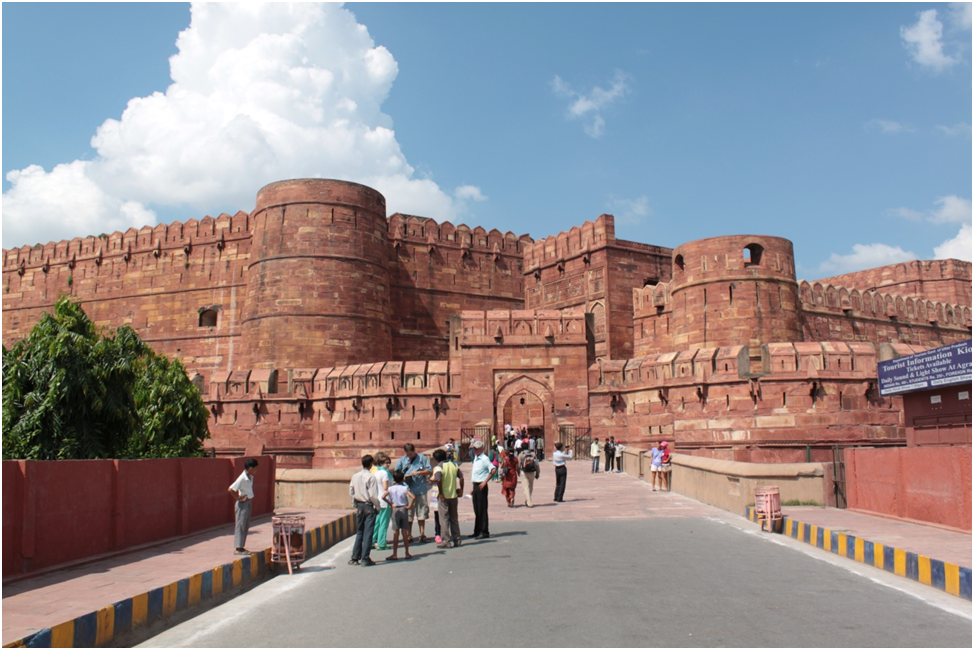
Agra Fort stands as a majestic symbol of India’s rich heritage, narrating stories of power, art, and architectural brilliance that have shaped the very essence of the nation. Located on the west bank of the Yamuna River in Agra, this UNESCO World Heritage Site (1983) is a testament to the opulence and vision of the Mughal Empire, showcasing intricate designs, exquisite inlay work, and expansive courtyards that reflect the grandeur of its time.
As visitors traverse along the fort, they can hear stories of emperors and battles, while the beautiful views of the nearby Taj Mahal adds to the elegance and beauty of Mughal architecture.
Often overshadowed by the iconic Taj Mahal, Agra Fort holds its unique importance, drawing history enthusiasts and architecture lovers alike.
Historical Significance of Agra Fort
The origins of Agra Fort trace back to the 11th century when it was a simple brick fortress under the Chauhan Rajput kings. It was mentioned for the first time in around 1080 A.D. when Ghazanavi’s forces captured it. Sikandar Lodi (1487-1517 C.E.) was the first Sultan of Delhi who shifted to Agra and lived in this fort. He governed the country from here and Agra assumed the importance of the 2nd capital. It was built over the remains of an ancient site known as Badalgarh.
After the death of Sikandar Lodi in 1517 C.E., his son Ibrahim Lodi held the Fort until he was defeated and killed in the battle of Panipat in 1526 C.E. by Babur, the founder of Mughal rule in India. Babur sent his son Humayun to Agra who captured this fort and seized a vast treasure including the world famous “Koh-i-Noor” diamond. Humayun was coroneted here in 1530 C.E. After Humayun’s defeat Sher Shah of the Sur dynasty occupied the Agra Fort
“Agra is the dearest city to me. It is the birthplace of my many dreams” — Emperor Akbar

It was in 1556 that Emperor Akbar recognized its strategic and political importance. In its present form, it was built by Mughal Emperor, Akbar, between 1565 to 1573 C.E. Its imposing red sand stone ramparts form a crescent along the Yamuna river front.
It includes a large group of royal buildings, showcasing styles from Akbar’s early eclecticism to the elegant designs of Shah Jahan. Over the years, the fort developed under Mughal emperors — Jahangir, Shah Jahan, and Aurangzeb — each contributing their unique architectural ideas and improvements.
Agra Fort played a crucial role in the administration of the Mughal Empire. It was not merely a military stronghold but a royal residence, witnessing political intrigue, cultural advancements, and legendary love stories. It was here that Shah Jahan was imprisoned by his son Aurangzeb, gazing at the Taj Mahal — his tribute to his beloved Mumtaz Mahal — from the confines of the fort.
The construction of the fort was entrusted to Kashim Khan who was Akbar’s Commander in chief and the Governor of Kabul. Akbar’s son Jahangir mostly resided at Lahore and in Kashmir, but visited Agra regularly and lived in the Fort. Though Shah Jahan, the son of Jahangir had transferred his capital to Delhi, formally in 1648 C.E., yet he still continued to live here.

After the down fall of the mighty Mughal Empire, Agra remained politically unstable. It was intermittently held by the Jaats and the Marathas. The British captured it from the Marathas in 1803. In 1857, the British had taken shelter to save their lives from the Mutineers and the public of Agra. Though this fort has lost the glamour and grandeur of the Mughal rule, yet it deserves a keen observation by the tourists.
Architectural Brilliance of Agra Fort
Agra Fort is a perfect blend of Persian, Timurid, and Indian architectural styles, creating a harmonious fusion of aesthetics and functionality. Built primarily from red sandstone, the fort also showcases the elegance of white marble, introduced by Shah Jahan.
Gates and Walls
The Agra Fort had four main gates but now only the famous Amar Singh gate and the Delhi gate are in use. The rest of the two gates namely, the Hathi gate and Khizri gate (water gate) have been closed permanently. Almost 2/3rd of the Fort is under Indian Army’s possession.
Agra Fort in its present form incorporates only a few buildings of Akbar’s period. The fort’s imposing walls stretch over 2.5 kilometers. The fort apart from the important units contains Jahangiri Mahal, Khas Mahal, Diwan-i-Khas, Diwan-i-Aam, Machchi Bhawan and Moti Masjid. Many extant buildings were erected by Shah Jahan during 1630-1655 C.E. On plan, the fort is an irregular semi-circle, enclosed by a double battlemented defense wall of red sandstone nearly 21.3 meter in height and about 2 km. in perimeter, interrupted by graceful curves and lofty bastions.

The impressive Amar Singh Gate to the south leads into the fort. The Amar Singh Gate, also known as the Lahore Gate, has massive wooden doors, iron spikes, and intricate carvings which reflect the defensive and decorative priorities of the Mughals.

The main entrance gateway to the Agra Fort is on the north side towards the city leading to the military area. The Delhi gate is also known as Hathi Pol because of two colossal sandstone elephants with their stone riders once stood on the platforms outside the gateways. In order to commemorate his victory over Rajputs Jaimal and Ratta, Akbar is believed to have put them here. Carving and fresco paintings are used to ornament this gateway. Two Persian inscriptions are found in this gateway, one belongs to the time of Akbar dated A.H. 1008 and the other belongs to the period of Shah Jahan.
Gardens and Geometry
The Mughal passion for symmetry and gardens manifests beautifully in the fort’s layout. Inspired by the Persian concept of Charbagh, the gardens within Agra Fort symbolize paradise on earth. The geometric precision in the arrangement of pathways, water channels, and green spaces adds a serene elegance to the fort’s robustness.
Anguri Bagh

This garden is rectangular in plan and has been laid in front of Khas Mahal on the north, south and west side it is surrounded two storied red sandstone buildings which consist of a series of rooms. Shah Jahan caused its construction in 1637 C.E. in the Khas Mahal, the garden has been planned on the formal Char-Bagh pattern. On the eastern side of the garden, there is a small marble tank. The center of the garden is occupied by a marble paved platform from which four marble paved pathways are radiating, thereby, dividing the garden into four quadrants. The marble pathways are again encircled by red sandstone pathways.
Water Structures
The water structures in Agra Fort not only served practical purposes but also enhanced the aesthetic and cultural dimensions of Mughal architecture. They highlight the advanced engineering, environmental sensitivity, and artistic vision of the period, making Agra Fort a masterpiece of heritage and innovation.
Baoli of the Diwan-i-Aam quadrangle

It is situated in the quadrangle of the Diwan-i-Aam. The Baoli is 7.92 meter in diameter and 24.37 meter in depth with rows of chambers around it and steps leading to the water. It was originally connected with river Yamuna through a tunnel.
Well in the Akbari Mahal

It is located north-west to the Akbari Mahal. It had been a cool retreat to the emperor Akbar in summer. Once it was connected with river Yamuna, which is now is blocked up. It consists of a well with five rows of chambers and steps leading to the water. The shaft of the well is 3.05 meter in diameter.
Other Notable Structures Within Agra Fort
Each corner of Agra Fort unveils architectural gems that reflect the Mughal emperors’ vision and tastes.
Akbar’s Palace

It is situated at the south-eastern corner of the Agra Fort between the Bangali burj on the south and the Jahangiri Mahal on the north, overlooking the moat on the river side. This Palace built of red sandstone consists spacious courts surrounded by large rooms as indicated by the foundation. The Bengali burj was also a part of it. Its construction is the trabeate order, but occasionally four centered arches are used as decorative arcading in its appearance but not in structure. The wall surface is rendered by string course, sporadic carving work, double brackets and eave boards
Diwan-i-Aam (Hall of Public Audience)

Constructed in 1636-37 C.E., it is situated within a great quadrangle adjoining the western wall of the Machhi Bhawan. The quadrangle is encompassed by colossal walls of Akbari Gate on the south, on the north by a wall on the roadside leading west-ward through Meena Bazar to the Hathi Pol and on the west by that of the arcaded cloister. This open hall, with its massive sandstone pillars and intricate arches, served as a venue for public audiences. Here, the emperor addressed the grievances of his subjects and held court sessions.
The Diwan-i-Aam is surrounded on three sides by arcaded cloisters. It consists of hypostyle hall and a throne room. The hall is also locally known as ‘Chahal Satun’. The hall is open in all the three sides. It stands on a plinth of 1.22 meter high and internally it measures 61 x 20.66 meter. It has triple row of colonnades, the outer ones, two on each side and eight in front being double whereas those at the corner quadrangle. The hall is covered by a flat roof, supported by 40 pillars and 3 aisles of 9 bays.
Diwan-i-Khas (Hall of Private Audience)

A more intimate and ornate space, Diwan-i-Khas was reserved for discussions with dignitaries and nobles. The famous Peacock Throne, adorned with precious gems, once graced this hall.
Diwan-i-Khas stands over the Shish Mahal to the north western corner of Saman or Muthamman Burj adjoining the inner eastern boundary wall of the Agra Fort. The court of the structure superimposes the eastern wall of the Machhi Bhawan and it faces the Shahi Hammam on the east side.
The Diwan-i-Khas consists of an inner hall and an outer hall, the former measures 12 x 20 x 7.93 meter while the latter 29.26 x 10.1 meter. both are connected by three archways. The outer hall is covered by a flat roof carried on multi-fold arches springing from the slender pillars. The pillars are of marble and walls are built of red sandstone veneered with white marble and embellished with beautiful carving and inlay work in floral design. A Persian inscription, inlaid in black marble in ‘Nastaliq’ characters assigns the erection of the building to Shah Jahan in 1636-37 C.E. figures along the frieze of the outer hall.
Jahangiri Mahal

It is situated at the south-east corner of Agra Fort overlooking the river Yamuna and the moat. It adjoins the Akbari Mahal on the north. It is a double storied structure, consisting of two courts, two vestibules and four wings varied in construction and design. Both trabeate and arcuate systems are used in the construction of the eastern wing.
A set of servant quarters runs along the back of the south wall, which are very exquisitely and elaborately embellished with intaglio stucco reliefs. The central court is faced on the north, by a hypostyle hall, profusely carved floral and geometrical designs. The flat roof is supported by four pairs of curious struts adorned with heads of elephants from whose mouth scrolls issued in the form of dragon interspersed with birds on the south side of the central court, there is the drawing room covered by wagon vaulted ceiling. The room is surrounded on the three sides by a lobby with wall shaving little screens superimposed by star shaped perforations.
Jahangir’s Hauz

It is a bath basin, placed in front of the Jahangir Mahal, facing its western entrance. It was originally found in 1857 C.E. lying buried in front of Jahangir Mahal. This bath basin is carved out of a single block of granite stone having steps inside and outside. It measures 7.62 meter in circumference and 1.22 meter deep. It bears a badly mutilated Persian inscription stating the name of Emperor Jahangir and its construction 1611 C.E. It is a remarkable example of Mughal engineering.
Khas Mahal

Built by Shah Jahan, Khas Mahal epitomizes the grace of white marble architecture. The delicate floral inlays and intricate carvings reflect his penchant for elegance and luxury.
Shah Jahan constructed this structure (Aramgah-i-Muqaddas) comprising a portico and a hall, flanked by a Partitions or pavilion on either side. It is laid out on a sufficiently elevated marble paved platform. The roof of the portico is surmounted on engraved and railing arches springing from the piers and abutments. The walls are decorated with dado, painted panels, painted in floral design.
A pavilion stands to the north of Khas Mahal is of entirely white marble with curved corners. The outer roof and curved sides are covered with gilt copper sheets. It was the residence of Jahan Ara Begum, the eldest daughter of Shah Jahan. The south pavilion is identical to the north one in construction and design except that it is built in red sandstone covered with marble stucco. It was originally known as Bangala-i-Darshan-i-Mubarak where from the Emperor Shah Jahan showed himself to his subjects every day.
Musamman Burj

This octagonal tower offers a poignant view of the Taj Mahal. It was here that Shah Jahan spent his final days, imprisoned yet comforted by the sight of his eternal tribute to love.
It is situated at the place where the defense wall takes a turn outwards towards the east. It stands north to the Khas Mahal and east to the Shish Mahal overlooking the River Yamuna. It is octagonal in plan and built by Shah Jahan for Mumtaz Mahal, not by Jahangir for Noor Jahan as many scholars believe. It is a two storied building made of white marble. The hall of the Saman burj has a shallow cistern with a fountain which is richly carved and inlaid with semi-precious stones. The vaulted roof was originally profusely embellished with Gold colors, precious stones were inlaid which were carried out by Jats.


Chittor Gates

The Gates are pierced in the western wall of Machhi Bhawan that opens to a passage east of Zanane Meena Bazar originally this fine gateway of the Machhi Bhawan was meant for their private approach to this Palace. Now it is provided with the bronze Chittor Gates. They have been brought here from the famous Fort of Chittor as a Trophy by Akbar who has captured the Fort in 1568 C.E.
Somnath Gate

This gate housed in the western most bay of the arcaded corridor at Shah Jahan Mahal. The Ghazni Gates (Somnath Gates) is an intresting relic of the Afghan Expedition in 1842 were erroneously identified with the gateways of Somnath. They have been wrongly identified to have taken away by Mahmud Ghazni from Somnath in 1025 A.D. The gates are made of deodar wood and decorated with Saracenic motifs and originally belonged to the tomb of Mahmud Ghazni. It is covered with arabesque designs. It bears an Arabic inscription in ‘kufic’ characters invoking blessings on Sultan Mahamood, son of Subuktgin.
Hon’ble John Russell Calvin’s Tomb

It stands on a brick edged paved courtyard in front of Diwan-i-Aam, on the south-west and within the quadrangle. He was Lieutenant Governor of North Frontier Provinces and stationed at Agra. On 05th July, 1857, during the first war of Indian Independence, the British troops suffered heavy losses and retreated to Agra Fort. He died of Cholera in the central room of Shah Jahani Mahal on 09th Sept., 1857. The tomb bears an inscription in English stating that Lord Calvin was born 29th May, 1807 and died here on 09th Sept., 1857.
Ladies bazaar attached to Nagina Masjid

It is believed to have been held in the arcaded corridor carried on a marble balcony projecting from the north enclosing wall of Machhi Bhawan. It is, on the west, connected to the Nagina Masjid by steps. The marble balcony has a central flat roofed hall with an open area on both sides which are enclosed in front by a lattice screen. A Tudor archway is incorporated at each end of the central hall which is faced by an arcade of three bays and a lattice rail is filled in between the columns. Brackets project out above the arches to carry on chajja which is crowned by the parapet.
Machchi Bhawan or Fish House

It is a large court, surrounded on the west by Diwan-i-Aam, on the east by Diwan-i-Khas, on the north by Nagina Masjid and other apartments and on the south by the Nagina Masjid and some residential quarters. It is a spacious rectangular court, surrounded by a series of rooms which are covered by flat roofs and enclosed in front by arcade at each side. The upper storey of Machhi Bhawan consists of a flat roofed gallery with arcades on three sloes at the level of Nagina Masjid and Diwan-i-Khas.
It is commonly believed that there originally existed marble tanks with fountains in which gold and silver fishes were kept for angling which amused the royal inmates. But it was used as store, according to the ‘Badshahnama’, for precious jewels and royal ornaments.
Maratha building impinging on the Nagina Masjid

Maratha building is situated to the north adjoining the mosque. When the Marathas had the Agra Fort under their control (1760-1803 C.E.) they razed down some structures north of the Nagina Masjid and made room for their own constructions. There structures are constructed utilizing red sandstone.
Royal baths

It stands at the north-eastern angle of the Agra Fort adjoining its inner defense wall, overlooking the river Yamuna. It has a set of vaulted chambers containing baths, walls of which are made of lakhauri bricks and coated with lime stucco. Traces of elegant embellishment in painting in floral design, although faint are still visible on the wall. According to ‘Badshahnama’, walls and ceiling were once exquisitely inlaid and adorned. The doors and riches were supplied with mirrors of Halab. The baths were provided with both hot and cold water.
Shish Mahal or Glass Palace

It is the basement of Diwan-i-Khas standing north-west to the Anguri Bagh, north-west to the Khas Mahal and south-west to the Saman Burj. It is a Turkish bath erected by Shah Jahan to serve Khas Mahal. The ceiling and walls are spangled over with tiny pieces of mirrors set in stucco reliefs which were, once, painted in gold color. The inner chamber has a cistern and waterfall interspersed with several candle niches where candles were kept burning under a sheet of water.
Salimgarh

It is situated on the highest elevated ground in the Agra Fort, south-west to the Diwan-i-Aam enclosure. Salimgarh is traditionally believed to have been built by Salim Shah Sur (1545-52 C.E.) and most probably it had been erected by Jahangir. Built in red sandstone, it is profusely and elaborately decorated with carved work chastely executed in bas-relief. It is a two storied pavilion, the super structure of which is exquisitely carved on the exterior.
Mosques within Agra Fort
Mina Masjid

It stands to the south-west corner of the Diwan-i-Khas and south corner of southern upper balcony of Machhi Bhawan adjoining the balcony itself. It is constructed entirely of white marble. Its court measures internally 6.71 meter only, is paved with alternate squares of marble and jasper and the sanctuary that measures 6.71 x 3.96 meter has a small mihrab in the qibla wall.
Moti Masjid or Pearl Mosque

It is situated on a high ground sloping from west to east on north side of road passing from Mina Bazar to Khizri gate just in front of north gateway of Diwan-i-Khas enclosure. Its well proportioned and graceful domes, groined vaults and intersections of cusped arches are remarkable features. The roof has elegantly carved pillars, joined by most exquisitely proportioned arches. Three lovely domes appear gracefully from partitions and kiosks crowning the walls and gateways, breaking skyline very beautifully and gracefully. A long Persian inscription is noticed on entablature in ‘Nastaliq’ character inlaid on black marble stating construction of mosque by Shah Jahan in seven years (1648-55) at cost of 3 Lakhs of rupees.
Nagina Masjid

It stands at north-west angle of the Machhi Bhawan at the level of Diwan-i-Khas and Shahi Hammam overlooking the court of the Diwan-i-Aam. The mosque presents the miniature form of the Moti Masjid. It is remarkable identical with the latter in respect of the contours of graceful domes and its cusped arches and even other minor details.
Nearby Monuments and Temples
Agra Fort’s surroundings are steeped in history and cultural richness.
No visit to Agra is complete without witnessing the ethereal beauty of the Taj Mahal. Located just 2.5 km from Agra Fort, this white marble mausoleum stands as a symbol of undying love.

Often referred to as the “Baby Taj,” this marble tomb showcases intricate pietra dura work and is considered a precursor to the Taj Mahal’s design.

- Mankameshwar Temple
One of the ancient Shiva temples in Agra, Mankameshwar Temple offers a spiritual retreat amid the city’s architectural marvels.

Best Time to Visit Agra Fort
The ideal time to explore Agra Fort is between October and March, when the weather remains pleasant. Visiting early in the morning or late afternoon ensures comfortable sightseeing and the chance to capture the fort’s beauty in golden hues.
Conclusion
Agra Fort is more than just a historical site — it’s a journey through time, an architectural masterpiece, and a symbol of the Mughal Empire’s grandeur. From its robust red sandstone walls to its delicate marble palaces, every structure within the fort tells a story of ambition, love, and artistic excellence. As you walk through its gates, you’re not merely a tourist but a witness to history’s silent whispers and timeless beauty. A visit to Agra Fort, coupled with its neighboring wonders, promises an unforgettable experience steeped in heritage and splendor.

Please send your valuable feedback