
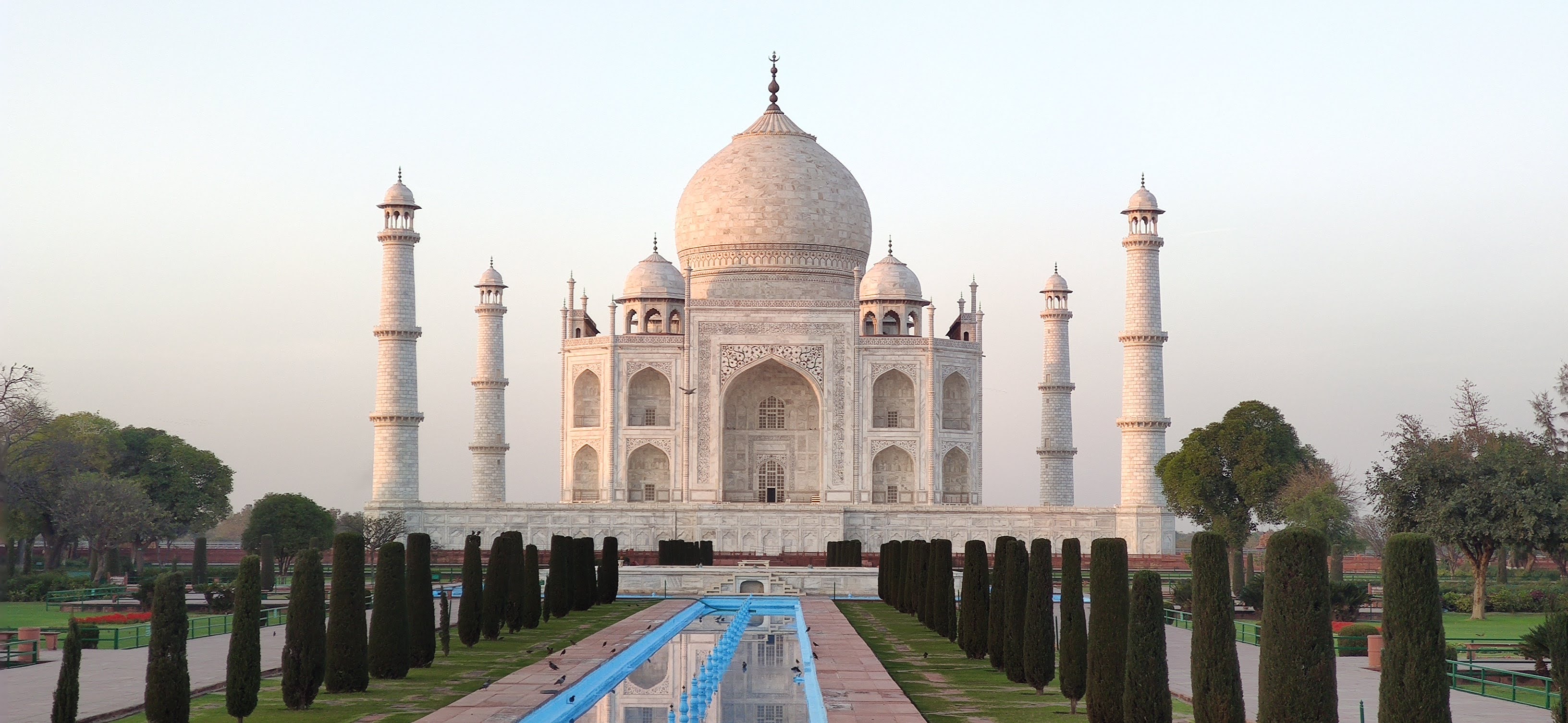
The Taj Mahal, aptly described as dream in white marble, is a masterpiece of Indo-Islamic architecture. It represents the remarkable engineering skill and perfection of construction devices as well as aesthetic ideals of the period. The monument was built by the Mughal emperor Shah Jahan (1628-58 A.D.) on the right bank of the river Yamuna as a garden tomb for his most favourite queen Mumtaz Mahal following her death in 1631 A.D.
Nobel laureate Rabindranath Tagore so beautifully put it, the Taj Mahal is indeed a “teardrop on the cheek of time”, reminding the world that love, beauty, and art can transcend the limitations of time and space.His words capture the ethereal beauty and timelessness of this architectural marvel.
History of Taj Mahal

Arjumand Banu Begum titled as Mumtaj Mahal after marriage was the daughter of Khawaja Abul Hasan, who was the brother of Empress Nur Jahan. Mumtaz Mahal (born in April 1593) married prince Khurram (emperor Shah Jahan) on 30th April, 1612 and died at Burhanpur with her royal husband bedsides her, while giving birth to their fourteenth child, on Tuesday, 17th June, 1631. Mumtaz Mahal was given a temporary burial in the building situated in the middle of a large tank inside the garden of Zainabad, opposite to Burhanpur, on the other side of the river Tapti. Exactly six months later, on 01 December, 1631, the corporeal remains of Mumtaz Mahal was sent to Agra, accompanied by Prince Shiya, Nawab Wazir Khan and the lady in waiting and agent of the late queen, Satti-un-Nisa Khanam, to be buried at the site selected there for her mausoleum. The corporeal body of Mumtaz, on arrival at Agra was placed at a temporary domed structure now located to the north-west corner of the garden.
Construction of Taj Mahal

The work of construction of this great monument started from the very foundation in the fifth regnant year December, 1631 / January, 1632 under the superintendence of Makramat Khan and Mir Abdul-Karim. The entire project was carried out in twelve years at a total cost of Rs. 50 lakhs. The inscriptions on the exterior of the western grilled door, southern arch of the cenotaph and northern arch of the main gateway bears the dates of A.H. 1046 (A.D. 1636-37) A.H. 1048 (A.D. 1638-39) and A.H. 1057 (A.D.1647-48) respectively, denotes presumably the year of completion various parts on which the inscription occur. The court historian Mullah Hamid Lahori gives a vivid description of the main the subsidiary buildings, but his account is restricted mainly to the architectural and decorative features, all the relevant information that can be gathered from Badshahnama is, first that foundations were laid by excavating down to the sub-soil water level, second, that masonry below the ground is of stone-in-lime and third that platform above the ground is of brick-in-mortar.

The principal materials used in the core of the tomb proper, its minarets and other accessory buildings is essentially brick (Lakhauri) and lime mortar. The external surface of the tomb building including its dome, drum, minarets, and interior of cenotaph chamber are lined with white marble veneering whereas all the other interior of all the other accessory buildings such as mosque, quest house, gates, etc. had been veneered with red sandstone except the exterior surfaces of domes. Besides in the accessory buildings a coat of red octate was applied over the thin layer of special lime plaster invariably provided on red sandstone surfaces basically for the purpose of proper protection of the stones as well as for the decorations. Further, all the important external and internal surfaces of the monument were embellished with rich variety of highly artistic and delicate inlaid or piertre dura ornamentation. The chief materials used in the inlay work include black marble, yellow marble, varieties of agate and jasper, coral, carnelian, turquoise, Jade, crystal, lapis-lazuli, garnet, onyx, chalcedony, amethyst, sapphire, diamond, etc. These precious and semi-precious stones were imported from different parts of the world where as white marble and red sandstone came from the quarries of Makrana, in District Nagaur of Rajasthan and Fatehpur Sikri in District of Agra of Uttar Pradesh respectively.
The main tomb building measuring 57.30 meter in width as well as height above the plinth level and identical in elevation of all four sides is located on a square platform of side 95.65 meter. The plinth itself rises about 6 m. above the ground level. The predominant feature of the structure is its 23 meter high dome from the springing to the base of 9.8 meter high gilded finial or pinnacle resting on a cylindrical drum of 18.4 meter internal diameter and rising 12 meter above the terrace roof. The drum is supported by eight octagonally arranged piers interconnected with arches. The octagonal main hall or cenotaph chamber thus created below the double dome measures 17.74 x 17.74 meter. in plan. This central hall is surrounded by four octagonal corner chambers measuring chambers measuring 8 x 8 meter and four square chamber of side 4.8 meter. These surrounding chambers also exist on the floor above and are interconnected by vaults at both the levels. In addition four minarets measuring about 5.8 meter in diameter at the base and 41 meter in height are located at the four corners of the plinth platform.
Layout and Plan of Taj Mahal

The layout plan of Taj Mahal was prepared by Ustad Ahmad Lahauri, a Persian descent from Lahore and Ustad Ismail Afandi of Turkey. Mir Abdul Karim supervised the construction of Taj Mahal. Shah Jahan, whose reign is known as the Golden Age of Mughal Art and Architecture, was himself had a great understanding of art.
During his life time his life time he had travelled various site and seen the excellent specimens of architecture including Mughal monuments. He was inspired by the earlier monuments like the Tomb of Hoshang Shah in Mandu, built in 1435, and admired this beautiful marble Mausoleum, its square plan and elegant marble platform. The elegant Tomb of Humayun in Delhi built by Mirak Mirza Ghiyas in 1565-1572 A.D. Humayun’s Mausoleum, its plan and elevation, is generally accepted as the proto type of the Taj Mahal. The Tomb of Khan-i-Khana Abdur Rahim Khan, Delhi, built in 1598 A.D. which is only a stone’s throw away from Humayun’s tomb is no doubt have drawn the attention and its important features studied by Shah Jahan as he was very familiar with Delhi monuments. Most probably he was impressed by four corner minarets of Akbar’s Tomb and added to the Taj Mahal.
Last but not the least the emperor Shah Jahan was greatly influenced by the most beautiful double storied, virtual gem in architecture, the mausoleum of Itimad-ud-Daula built by Nur Jahan in 1622-28 A.D. For the first time the finest specimens of Italian inlay work called Pietra Daura was introduced in India. During Shah Jahan’s patronage, Mughal building reached new levels of refinement. Previously Mughal buildings had primarily been constructed of red sandstone; and Shah Jahan promoted the use of white marble inlaid with semi-precious stones.
Inscriptions

Bands on both sides of the arches and the cenotaphs contain inscriptions in Thulth and Nastaliq style of calligraphy. The Quranic chapters 46, 81, 82, 84, and 98 are inscribed on the western façade with date 1046 A.H. (A.D. 1636-1637). The Quranic chapters 67, 68, 77, 39, 41, 40, 83, 21, 59 are inscribed on the cenotaphs. On a band on the southern façade the death of Mumtaz Mahal is recorded in 1040 A.H. The cenotaph of Shah Jahan is inscribed in Persian language and Nastaliq character, which records a date of 1076 A.H. The cenotaph of Mumtaz Mahal is inscribed with Quranic chapters 39, 03, 23 and 59. On the eastern and western faces the ninety nine names of God are inscribed.
Some Important Structures in the Taj Complex
The Masjid (A.D.1642-1648)

Stands at the western end of the great basement to the west of the main mausoleum. The mosque is built of red sandstone and the façade is sparsely decorated with marble inlaid in red sandstone in floral and geometrical patterns. Rectangular in plan each quoin of the mosque is attached by an octagonal tower crowned by a cupola. The mosque is crowned by three graceful marble domes, the middle one being larger than the rest. It has a Muluk-Khana at the northern side of the sanctuary which was separated for females by lattice work. North-west to the mosque and abutting on it there is a baoli or stepped well.
The front quadrangle of the mosque is adorned by an ablution tank at its centre. The anterior surface of the mosque walls, soffits and ceiling are decorated with intaglio incises painting. The spandrels of arches are embellished with inlay work.
Inscription: On the band of mihrab of the quibla wall, the Quranic chapter 91 is inscribed in Nasq character; on the side wall, chapter 112 is inscribed in Tughra character.
The Jawab or Mehman Khana(A.D.1642-1648)

The Mehman Khana is situated just opposite to the mosque at the eastern end of great basement to the east of main mausoleum. The design and construction is very much similar to the Masjid. The main function of the building was to serve as an assemble hall, it is known as Jamat Khana or Gathering place.
Four Minars at the corners (A.D.1642-1648)

The Taj Mahal complex is enclosed by high wall with embattles parapets. At each corner of this wall an octagonal tower, surmounted by a cupola is located. A two storeyed structure they are octagonal in plan and built of red sandstone. Each storey is octagonal in plan consisting of an archway, at its each side. From the frieze of the upper storey carved brackets projects out to carry the eave. The outer surface of the tower is cut up into panels which are decorated with carved and inlaid work in floral and geometrical patterns.
Each 40 m. (131 ft.) high and crowned by an open octagonal pavilion of chhatri, frame the tomb, highlighting the perfect symmetry of the complex. The Minarets of Taj Mahal are reminiscent the gateway of Akbar’s Mausoleum at Sikandra, and which are sited at the angles of the massive marble platform. These are artistically designed, three tiered minarets. The first storey gallery of the minarets is level with the floor of mausoleum. The second storey gallery is level with the second floor of the mausoleum. The third storey gallery of the minarets is level with the top of the dome.
The Dome of Taj Mahal

The dome of Taj Mahal referred by Abdul Hamid Lahori and Muhammad Salih Kambo as amudi-shakl or “pear shaped”, is raised over high drum. The crowning element of the dome is the lotus petal with rope-like molding above and below. The 44 meter (144 ft.) double dome is capped with a finial. The dome of Taj Mahal is surrounded by four Chattris similar to that of Hindu panchayatana shrine. The idea probably inspired from the Hoshang Shah’s tomb in Mandu, which has been employed for the first time in the Islamic architecture.
The Cenotaphs

The cenotaph of Mumtaz Mahal is at the exact centre of the tomb chamber. It is placed on a rectangular platform decorated with inlaid flower plant motifs. Over the cenotaph of Mumtaz Mahal is the depiction of a slate and over that of Shah Jahan is a pen case. It is believed that a man would write the desires of his soul on the heart of the woman, and she would fulfill them in heaven as she had done on earth. The cenotaph of Shah Jahan is larger than that of Mumtaz Mahal and installed more than thirty years later in 1666, by the side on its east. The upper cenotaphs are only illusory and the real grave is in the lower tomb chamber, a practice commonly adopted in imperial Mughal mausoleums.
Great South entrance gateway (A.D.1642-1648)

The southern gateway is situated at the centre of the southern enclosure wall of the Taj garden complex. It is a two storeyed structure built entirely of red sandstone. It has an iwan on both facades and a domed central hall which has externally a central apsed entrance is flanked by two superimposed apsed recesses. The spandrels of the arches are adorned with undulating arabesque patterns, inlaid with multi hued semi-precious stones. A parapet with marble inlaid face encircles the roof except along the high walls which are adorned by a band of inlay. The gateway has a central iwan devised in a semi-octagonal plan. The iwan is crowned by a lofty domes vault and adorned with a network of stalactite designs in white stucco on red background. The iwan has at four corners, an octagonal room on raised platform.
The Charbagh or garden

Babur the first Mughal Emperor of India who inherited the garden tradition from Timur and made serious attempt to found typical Timurid-Persian gardens in India. Shah Jahan, as a true artist studied beauty from every aspect, including that of gardens. Ran Mal from Kashmir was the chief designer of Charbagh garden. The present garden is divided into four quadrants by two main walkways and each quadrants in turn sub divided into four sub-quadrants by narrow walkways. The main walkways consist of swallow canals which contain a line of fountains in it. And water was supplied to the garden through two Persian Wheel Lifts run by bullocks.
Architectural Marvel

The Taj Mahal is a stunning example of Mughal architecture, blending Persian, Islamic, and Indian influences. The structure is primarily made of white marble sourced from Makrana, Rajasthan, and is adorned with intricate inlay work using semi-precious stones such as jade, turquoise, amethyst, and lapis lazuli. The central dome, rising to a height of approximately 73 meters, is flanked by four elegant minarets that enhance its symmetry and grandeur.
Calligraphy, featuring verses from the Quran, embellishes the entrance and walls of the mausoleum. One of the most prominent inscriptions reads:
“O Soul, thou art at rest. Return to the Lord at peace with Him, and He at peace with you.”
This poetic verse symbolizes the spiritual and divine essence of the Taj Mahal.

Visiting the Taj Mahal is a magical experience. The best time to see it is at sunrise or sunset when the changing hues of the sky reflect on the marble, creating a mesmerizing effect. The gardens, inspired by Persian-style charbagh layouts, provide a tranquil atmosphere for visitors to soak in the beauty of the site.

A night visit during a full moon offers an ethereal experience, as the Taj Mahal shimmers under the moonlight, exuding an almost otherworldly glow.The Taj Mahal is more than just a monument; it is a story of undying love, artistic brilliance, and historical grandeur.
Whether viewed as a masterpiece of architecture or a symbol of romantic devotion, it continues to captivate hearts across generations.


Please send your valuable feedback