
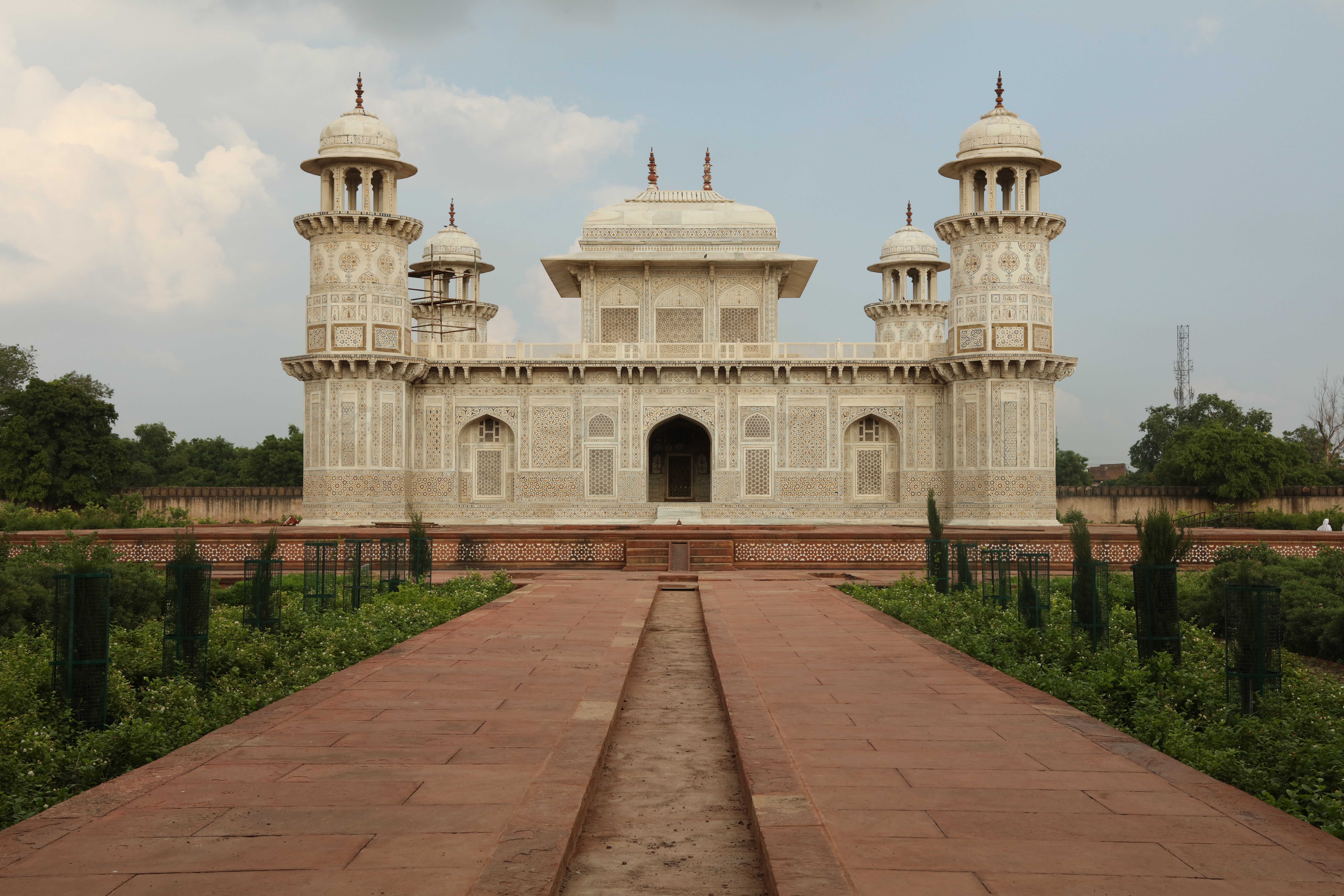
Agra is a city synonymous with the grandeur of the Mughal era. It is home to some of the most iconic and stunning monuments in India. While the Taj Mahal often takes the spotlight, the Itimad-ud-daula’s Tomb, often called the “Baby Taj,” stands as a masterpiece of elegance and intricate design.
This mausoleum is more than just a precursor to the Taj Mahal; it is a vital chapter in the evolution of Mughal architecture and a gem that reflects Persian influence and Indian craftsmanship. Let’s take a journey through its history, architecture, and cultural significance.
HISTORICAL SIGNIFICANCE
The Tomb of Mirza Ghiyas Beg, entitled Itmad-ud-daula, is situated on the left bank of the Yamuna River. It is lyrically described as a “Jewel box in marble”. The small yet elegant garden tomb of Itimad-ud-daula, the “lord treasurer” of the Mughal Empire, was built by his daughter Nur-Jehan, the famous consort of Jehangir, between 1622 and 1626.
Mirza Ghiyas was the son of Khwaja Muhammad Shariff who was the Vazir (Prime Minister) of Khurasan and then of Yazd under the Safawid Emperors of Persia. Mirza Ghiyas came to India and rose high in the Imperial service during the reign of Akbar. After the marriage of his daughter to the Emperor Jehangir in 1611, he was made commander of 6000 zat (personal) and 3000 sawar (horsemen). He held the title of ‘Itmad-ud-daula’ or the Lord Treasurer of the Mughal Empire, and died in 1622. Nur Jehan her own tomb and that of her husband Jahangir’s tomb (in a similar style) are at Lahore.

Before Taj Mahal was built, this was the most famous structure in the Agra city. The Itmad-ud-daula tomb sometimes referred as baby Taj was laid out during the life time of Mirza Ghaiyas, reminiscent of the Persian spring, were grown here. Cypresses were planted near the walls to retain an unobstructed, full view of the tomb in the center.
The tomb’s construction reflects Nur Jehan’s immense political influence and her deep affection for her father. It also marks a departure from the red sandstone used in earlier Mughal structures, embracing the elegance of white marble. This transition would later culminate in the construction of the Taj Mahal.
LAYOUT OF THE TOMB
“The world believes it was built by love, but even the smallest stone here speaks of power and artistry” — Anonymous

The Itmad-ud-daula tomb is quite different from the other Mughal structures in terms of architecture. The sight of tomb is fascinating even it was not as big as Taj Mahal. Built entirely of white marble and inlaid with semi-precious stones, coloured mosaic and lattice work this mausoleum on the banks of the river Yamuna, exhibits a strong Persian influence. Began in 1622, it took six years to complete.

Stylishly this is the most innovative 17th-century Mughal building and marks the transition from the sturdy and manly red sand stone architecture of Akbar to the sensuous refinement of Shah Jahan’s Taj Mahal.
The square two-storeyed tomb is located at the centre of a quadrangle with gardens laid out on the charbagh pattern surrounding it and enclosed on all sides by high walls typically of Persian style, this 540 feet square plot has four gateways in red sand stone. The tomb is of white marble stones stand over a raised sand stone terrace. At the four corners of the low platform are four squat attached minarets. The dome, with its canopy- like shape, is different from the conventional domes of this period.

ARCHITECTURAL SIGNIFICANCE
The Itimad-ud-daula’s Tomb stands as a brilliant example of Mughal architecture’s transition from robustness to refinement. The structure is made entirely of white marble and adorned with delicate inlay work using semi-precious stones.
1. Persian and Mughal Fusion
The tomb draws heavily from Persian architectural styles, especially in its use of symmetrical gardens, intricate geometric designs, and the extensive use of marble. This fusion creates a harmonious balance between strength and elegance.
2. Pietra Dura: The Art of Inlay Work
One of the most striking features of the tomb is its exquisite pietra dura (pachchikari) work. Semi-precious stones like jasper, onyx, topaz, and lapis lazuli are inlaid into the marble to create intricate floral patterns. This technique reached its zenith with the construction of the Taj Mahal, but its early mastery is evident here.
3. The Garden Complex
The tomb is set within a traditional Charbagh garden — a Persian-style quadrilateral layout symbolizing paradise. Divided by water channels, the garden reflects the Mughal love for symmetry and nature’s beauty. The gentle sound of flowing water and the meticulously manicured lawns create a serene ambiance.
“In the symmetry of these gardens lies the vision of paradise, meticulously crafted on Earth” — Unknown
4. Geometric Precision
Every element of the Itimad-ud-Daulah’s Tomb is meticulously measured and aligned. The balance between the tomb, the entrance gateways, and the water channels showcases the Mughal obsession with geometric perfection.

THE MONUMENTS WITHIN THE COMPLEX
The Itimad-ud-daula’s complex is not limited to the central mausoleum. Several structures enhance the beauty and historical significance of the site:
- Main Mausoleum: The centerpiece, built entirely of white marble, stands on a red sandstone platform. Its intricate inlay work and jali (lattice) screens allow light to filter through, creating a mesmerizing play of light and shadow.
- Gateway Structures: The complex has grand red sandstone gateways adorned with marble and intricate floral designs. These gateways set the stage for the splendor within.
- Pavilions: There are several small pavilions around the complex, adding to the grandeur and providing shaded resting spots.

The building consists of a central hall, parallelogram in shape, which houses the tomb of the Wazir and his wife Asmat Begum. The hall is surrounded by small chambers in which the tombs of other family members including that of Nur Jahan’s daughter Ladli Begum through her first husband Sher Afkun (popularly known as Sher Afghan) are located. A sand stone staircase leads to the first floor; where an elegant oblong dome is found surmounting a pavilion over the central hall, topped with two pinnacles with lotus mouldings crown the minaret. This pavilion also contains cenotaphs of plain marble but without any inscriptions. At the corners of the top of the building stand four round towers approximately measuring 40 feet in height surmounted by marble kiosks.
The Cenotaphs and walls of the ground floor contain inscription in Persian language. The wall inscriptions are from Quran and other holy texts, while the cenotaph inscriptions are stating the name and title of those internees.

A little later than the completion of Akbar’s tomb, inlay work in precious stones was introduced. Manabhat-kari or Pietra dura the polished marble surface is covered with stone inlay, the first time this technique was extensively used in Mughal architecture, originated from the rough type of mosaic work in stone in the earlier Mughal monuments. Pietra Dura is a European technique of inlaying colored semiprecious stones in marble became a favorite building trope of the Mughals in the 17th century. The technique is called by its Italian name of Pietra dura, which simply means hard stone.

The tomb of Itmad-ud-daula is noted for profuse ornamentation in polychrome and mosaic pattern over its whole surface. Flower vase (Guldasta), rose-water vases, grapes, wine cups and flasks, Cyprus and other Persian motifs are freely employed in the scheme of ornamentation. The animal motifs have been depicted in painted designs mostly inside the jar shaped guldastas. Interestingly human figures are also depicted in the scheme of painted panels. In the tomb chamber the ceiling has incised, painted and gilded stucco and stalactite patterns. The yellow marble caskets appear as if carved out of wood.
The main entrance to the tomb is on the east, while ornamental gateways have been constructed on north and south sides. On the west in its middle has a multi storied pavilion with cells over hanging the river Yamuna. The shallow water channels, which originally received water from two tanks on the river side’s, run all around the sides of the garden and the Mausoleum.
As with all Mughal monuments, the distribution of flowing water throughout the complex was carefully considered architectural element. water ripples down an inclined ramp (the water fall between the steps) to run through channels cut in the pavement.

INFLUENCE ON CONTEMPORARY MUGHAL MONUMENTS
The sculptural wonders during the reign of Jahangir include the sculpture of Mausoleum of Akbar and the Tomb of Itmad-ud-daula. The tonal warmth and opulent decoration characterized the buildings built during this time. The Hindu architectural elements almost disappeared from the sculptures during Jahangir era.
The buildings of Akbar and Jahangir are strongly influenced by Hindu forms, and are generally built in red sand stone and carved both on the exterior and interior with geometrical, floral and even animal forms. This is particularly the case with the Fatehpur Sikri buildings and the so-called Jahangir’s palace in the Agra Fort.
Jahangir did not build much, but he has left us a few fine specimens of his work, notably the tomb of Itmad-ud-daula, his palace in the Agra Fort and his father’s tomb. Due to profusion of intricate work done on marble and the beautiful single slab of marble screen work, the tomb easily qualifies as a veritable for e runner of the famous Taj Mahal.
BEST TIME TO VISIT

“Agra’s winter air carries whispers of history, and in the golden light, the Baby Taj glows with timeless beauty” — Traveler’s Journal
The best time to visit Itimad-ud-daula’s Tomb is from October to March when the weather is pleasant and perfect for exploring outdoor sites. Early mornings and late afternoons offer the best light for photography, highlighting the intricate details of the monument.
NEARBY ATTRACTIONS
Agra is a treasure trove of historical wonders. While visiting Itimad-ud-daula’s Tomb, you can also explore:
- Taj Mahal (4 km): No visit to Agra is complete without marveling at this symbol of eternal love.

- Agra Fort (3 km): A UNESCO World Heritage site, this fort offers a glimpse into Mughal military architecture and royal life.

- Mehtab Bagh (5 km): Perfect for a sunset view of the Taj Mahal, this garden complements the Charbagh layout of Itimad-ud-Daulah’s Tomb.

- Chini ka Rauza (2 km): A lesser-known but equally beautiful monument, known for its unique glazed tile work.

CONCLUSION: A MUST VISIT HISTORICAL GEM
Itimad-ud-daula’s Tomb stands as a testament to the love, power, and artistic brilliance of the Mughal era. Its unique architecture, intricate inlay work, and serene gardens make it a must-visit for history enthusiasts and architecture lovers. As you walk through its symmetrical pathways and admire the delicate craftsmanship, you’ll find yourself transported to a world where art and legacy intertwine.
Whether you’re an avid historian, a lover of architecture, or a casual traveler, this “Jewel Box” of Agra promises an experience that is as enriching as it is enchanting. Don’t forget to bring your camera — the Baby Taj’s beauty deserves to be captured and cherished.

Please send your valuable feedback