
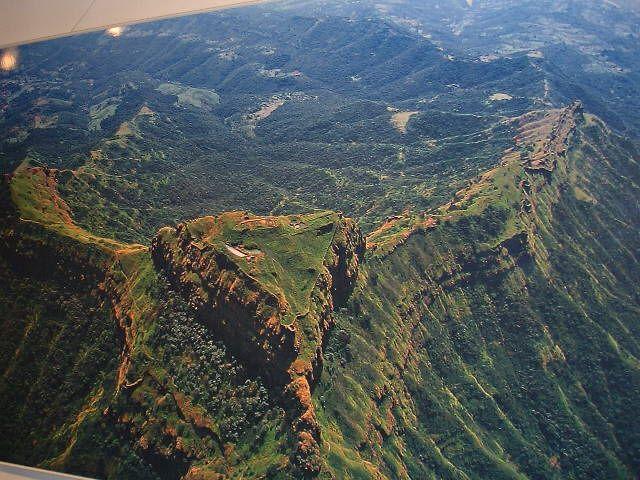
Narnala fort is one of the imposing and intricate hill forts in Melghat region surrounded by Satpura hill ranges. The fort is also known as “Shahanur Fort” (‘shah’ meaning king and ‘nur’ meaning light of all forts) and was declared protected by Central Government in 1925. It is situated 36 miles north of Akola.
The region encompassing the Narnala hill has also been declared as Wildlife Sanctuary and a protected forest. As per oral tradition the fort was built by the Gonds. When Ahmed Shah Bahamani (1425 C.E.) constructed Gawilgarh fort with a view to obstructing the invaders from the north frontiers of his kingdom he also repaired Narnala fort. The fort was under various dynasties like Bahamani (1347-1527 C.E.), Nizamshahi (1490-1636 C.E.), Mughals (1526-1707 C.E.), Marathas (1674-1818 C.E.), and Nizam of Hyderabad (1724 C.E.) and eventually fell into the hands of East India Company who took over it in the year 1818. The fort also played an important role during the upheaval of pendharies in the year 1857.


Raja Narnal Singh or Narnal Singh Swami was a scion of Chalukya ruler, on whose name the fort is named after. Subsequently, every ruler of Narnala has left his impression in its architectural remains from classic Bahamani gateways, lofty Mughal arches, Maratha gardens and pleasure pavilions etc. Narnala is a unique existing fort with triple fortification walls, numerous bastions, wide wall walks, lofty arched gateways, artificial lakes, palaces, stables, audience hall, mosques, gun foundry and all components are distinctive varieties. Besides defence architecture, water management system visible in form of dams, reservoirs and artificial lakes is testimony of the skills of the medieval engineers.
Its walls are spread over an area of 38 km and are one of the longest fortification walls in terms of length in the world history of fort architecture. The fortification walls on top of the hill are spread over an area of 392 acres; originally it had 22 gates and about 360 bastions. The gate complex consists of two arched entrances along with arched guard chambers. The gates like Shahanur (Vagh darwaza), Mehandi, Mahakali (Nakshi Darwaza), Akot & Delhi are a true testimony of the Bahamani architecture. The Mahakali gateways is also a good piece of work. On the upper portion of Mahakali gateway (Nakshi Darwaza) comprises two large inscriptions, belonging to Bahamani period.

A scenic view 
Site plan – Courtesy ASI Nagpur circle 
AMBARMAHAL-VIEW-FROM-NORTH 
BARADARI-ENTRANC-GATE-VIEW-FROM-EAST 
Baradari 
Baradari-2 
BAROOD KHANA – Ammunition room 
Mendha-gate-1 
Mendha-gate-2 
Mendha-Gate-interiar-view-from-west 
MOSQUE-VIEW-FROM-EAST 
Narnala-Mahakali-gate-1 
Narnala-Mahakali-gate-2 
Narnala – The main gate arches 
Navgaj-canon-1 
Navgaj-canon-2 
Mehendi gate
The notable structures in the fort are Gajashala, Ambar Mahal, royal harem or Zananakhana, Jama Majjid, telache tupache tanke (Tank of Oil and Ghee), nagar-khana, khuni burj, Karkhana (gun foundry) and several Muslim tombs and dargahs. The gun foundry(Karkhana) is located to the east of Nakshi gate set up by the Mughals.
In the Kardhana system of producing canons a particular system of production of cannons a type known as ‘fagot’, is one of the finest and largest pieces of artillery in India. Instead of casting entire barrel, prefabricated iron rings were forged together with horizontal iron staves. This is probably the only surviving evidence of the gun foundry on any hill fort of Maharashtra. The ‘Navgaj canon’ along with two other canons is notable for their size and manufacturing technique.
The Ambar Mahal (Kachehari) is the most imposing structure consisting arched rectangular hall open from one side provided with three chambers. The roof consists of a central and two side domes designed with floral pattern. It was converted into a residential complex during the British period by putting stone partition walls and covering arched openings.
The area known as stable (Gajashala) seems to be Royal Complex located to the west of the Ambar Mahal. There are interconnected series of chambers by low archways known as zanan khana. Adjoining to this a small but neatly built mosque stands in good state of preservation known as Jama Masjid. This is a small but beautifully built structure provided with three arched halls in double rows and a mehrab facing west. To the south of Ambar Mahal is a block of four large, covered cisterns with graceful arches rising above them, locally called telache tupache tanke.
The whole sweep between Shahanur fort and Narnala hill is known as Sati Maidan as many Sati stones are noticed here. The fort is also full of Muhammedan tombs. Near the Akot and Delhi gateways are situated the domed tombs of Bagh Savar Wali and Gaz Badashah Wali, near the Ambar Mahal lies the tomb of Burhanuddin, to the south-west of the fort lies the tomb of Saidulliboa or Saidulliwali. On the eastern side of the fort has a grave of European officer who died in the battle of Adgoan, structures like nagar-khana where prisoners were kept and khuni burj from where criminals were hurled down to their deaths as punishment.
Inscriptions
The upper inscription on the Mahakali gate opens with the words “On the date of Victory” followed by a text of the Kuran (urah III.N. I) which is ingeniously used as a chronogram which give the date of the building of the gate as AH 893 (AD 1487) which is also expressed in words. It then goes on with the creed of Islam and pours blessings on the heads of prophets, angles, Khalifas generally, and the 4 successors of Muhammad in particular. By this we know that the builder of the gate was a sunni. The words “On the date of the victory” at the beginning of the inscription probable refer to the slaughter of the Turki Amirs and troops at Bidar at the instigation of Nizam-ul-mulk Bahri, carried out under the orders of Fatah-ullah Imad –ul-mulk.
The lower inscription informs us that the gate was built in the reign of the great and exalted kings the Ghazi Shahab-ud-dunya-wad-din Mahmud Sahah, the son of Muhammad shah, the son of Humayun Shah the son of Ahmad Shah, the son of Muhammad Shah Bahamaii and concludes with a prayer for the endurance of his rule. Major Haig considers the genealogy given above as inaccurate. In the first place it omits from his pedigree the name of Alauddin Ahmad Shah II, for the Ahmad Shah mentioned is evidently intended for Shahabuddin – Ahmad Shah I, father of Alauddin and in the second place it errs in making Ahmad I the son of Muhammad Shah the fifth king o the dynasty.
The canon inscription (navgaj) states that it was cast when the Dakhnis ruled and that Altubaig the slave of the Imperial Court, having arrived at Narnala in the moth of Jamadi-ul-Awwal of the Hijri year 1091 (AD 1680), mounted it on the knoll which nobody did, although the gun had been captured 150 years ago. It is evident that Altubaig was proud of his achievement. The canon according to the inscription was captured in AH 941 (AD 1534- 35). This cannot have been the date of its capture by the Mughals, for Akbar, who was the first of that dynasty to invade Berar, did not ascend the throne till 1556.
The masjid inscription records the date of a visit by the Nawab Khurshedjah, son in law of Afzul-Uddaulah Badshah in the Hijri year 1291 (AD 1874) and is of not much historical importance.
How to reach
By Air
Nearest Airport: Dr. Babasaheb Ambedkar International Airport in Nagpur (about 180 km from Narnala Fort).
By Train
- Nearest Railway Station: Akola Junction, approximately 50 km from the fort.
By Road
- From Akola: Narnala Fort is about 50 km away. You can hire a taxi or drive.
- From Amravati: Approximately 80 km. It’s a scenic drive with well-maintained roads.
- Public Transport: Buses and taxis are available from Akola and Amravati to Shahanur or Takaipura village, which are the closest settlements to the fort.
Timings
Sunrise to Sunset except Government holidays.
Best time to visit
October to March
Places to stay
Nearby places to visit
- Akola Fort, Akola city, approximately 50 km from Narnala Fort.
- Balapur Fort, Balapur, around 80 km from Narnala Fort.
- Chikhaldara Hill station, Melghat Tiger Reserve – About 100 km from Narnala Fort.
- GAWILGARH FORT in Chikhaldara, 125 km from Narnala Fort.
Sources
2. Archaeological Survey of India (New Series) Vol XIX list of Antiquarian Remains Central Province and Berar., Compiled by Henry Cousens, Office of the Superintendent of Government Printing, India Calcutta (1897) Page No.: -72
3. Naravane M. S., Forts of Maharashtra ., S. B. Nangia, for APH Publishing Corporation 5 , Ansari Road , Darya Ganj, New Delhi 110002 (1995).


Please send your valuable feedback