
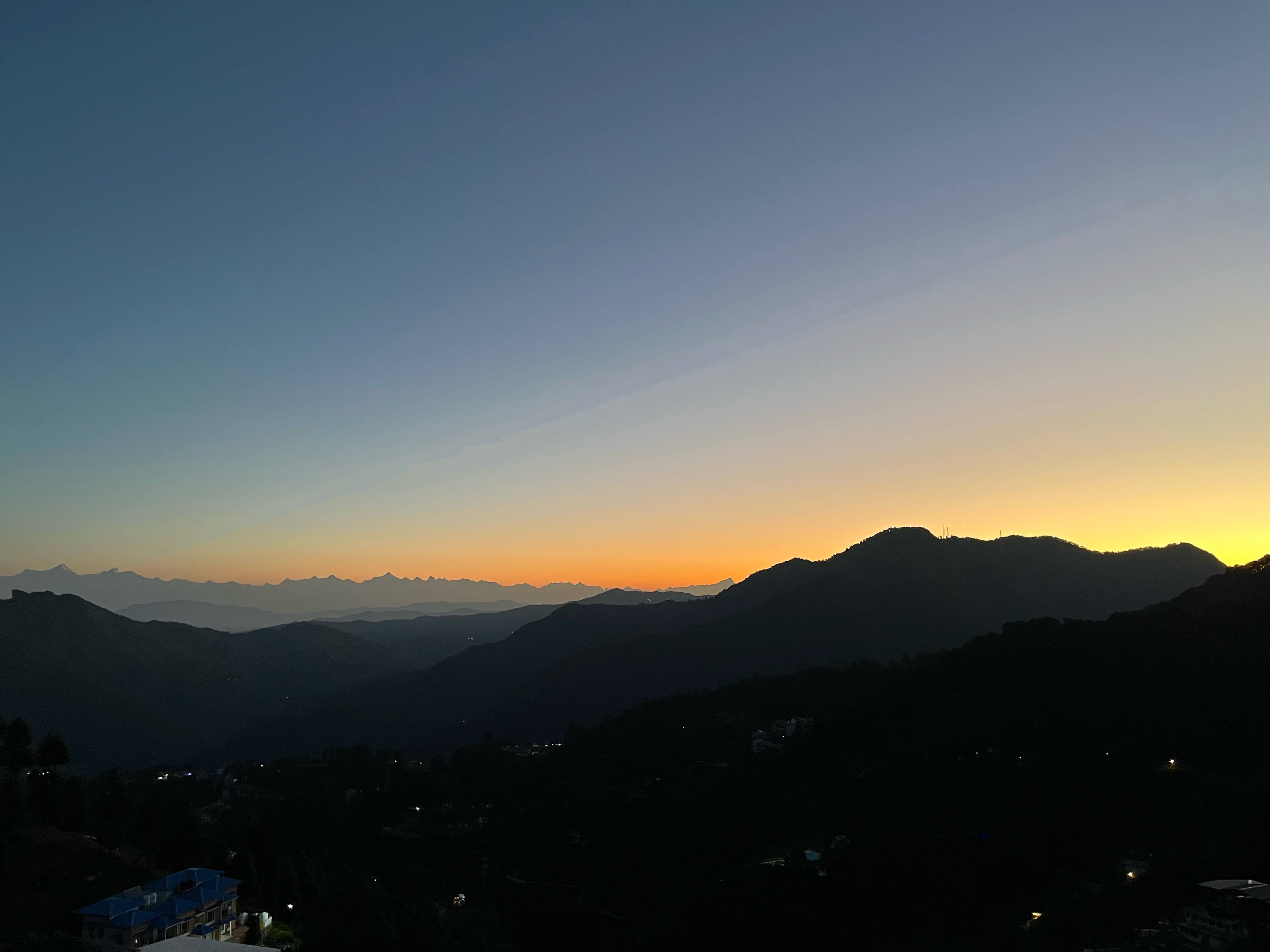
“Autumn is a second spring when every leaf is a flower.” — Albert Camus
I borrow Camus’s idea because walking Kumaon in October and November feels exactly like stepping through another spring of flame: every tree an arrangement, each hill a catalogue of warm tones. The mountains here do not throw an ephemeral party of colour and disappear; the season is a slow, intimate performance that rewards those who step out early, wait, and look closely.
This is a long, human piece — part travel essay, part natural history, part cultural note and photography guide. I walk you through places (Nainital’s terraces, Almora’s ridges, Binsar’s oak pockets, Kausani’s Himalayan vistas), through the species that paint the slopes (the oaks, rhododendrons, birches and understory shrubs), and through the science of why leaves turn the colours they do across elevations. I also weave in local festivals, sensory vignettes, and practical advice for seeing autumn at its best. Where research strengthens the story — phenology, elevation effects, species notes — I mention it naturally and point you to the relevant studies, so you can read deeper if you like.

1. Where Kumaon Sits — A Short Geographical Primer
Kumaon is the eastern half of what Indians call Uttarakhand’s Himalayan belt: a stitched landscape of valleys and ridgelines that slope from the high Greater Himalaya down into the gentle submontane plains. Elevations range widely — from a few hundred metres near the Terai to peaks that climb past 6,000 metres — but when people speak of “autumn in Kumaon” they usually mean the middle elevations: 1,200–2,600 metres, the zone where broadleaf temperate forests flourish and deciduous trees stage their most dramatic changes.
This altitudinal band is where oak-rhododendron mixes dominate, where the shallow soils hold a concentrated palette of chemical pigments, and where temperature swings between day and night choreograph the timing of colour. For anyone who loves autumn, this is the sweet spot: not the brittle, early snow of higher altitudes, and not the tropical green of the lowlands — but a slow, temperature-driven, pigment-rich theatre. Recent studies on seasonal dynamics across the Kumaon elevation gradient confirm that start-of-season and end-of-season dates vary predictably with altitude, vegetation type and microclimate — a pattern you can observe by watching valley bottoms and ridgelines peel through colour over a month or more.
2. The Cast: Trees and Shrubs That Paint Autumn in Kumaon
When people imagine autumn they often think maples and birches. Kumaon’s story is a little different and better for it: the colour here is an ensemble cast.
Banj oak and other oaks (Quercus spp.)
In mid-elevation forests, oaks — locally called banj oak (Quercus leucotrichophora) among others — are the large, smoky frames that hold entire slopes together. In autumn they shift through bronze, copper and russet. Oak leaves don’t always turn a single sharp colour; they hold a range of warm tones that read like aged brass against evergreen pines. Phenological studies on oak in the Kumaon Himalaya show that the timing of leaf senescence varies across elevation and influences understorey light, soil nutrient cycles, and ecosystem functioning — which is why oak pockets often look like islands of slow-burn colour.
Rhododendron (Rhododendron arboreum and cousins)
Rhododendrons in the Himalaya are famous for their spring florals, but in autumn their foliage and the older flowering calyces can add a crimson or dull red underglow to the understorey. Rhododendron arboreum is common in Kumaon’s forest mosaic and shows pronounced phenological shifts with elevation; monitoring work across the region documents how flowering and leaf cycles change with microclimate — and that timing influences autumn display as well. Look for them as bright accents beneath the oaks and pines.
Himalayan birch and alder
Where water is a touch more plentiful and the soils are deeper, birches and alders turn a bright yellow that, when caught in sunlight, gleams like coin. These species often edge streams and small gullies, creating ribbons of light along valley floors.
Understory shrubs, grasses and lichens
Don’t ignore the red berries, the seedheads, and the grasses that shift to rust and gold. Many small shrubs and groundcovers — as well as the lichen-covered trunks of older oaks — add texture and contrast to the major colour blocks. Recent studies using UAV remote sensing (drone data) over rhododendron and mixed forests in Kumaon have even mapped chlorophyll declines and senescence in high spatial detail, revealing how complex and fine-grained the autumn mosaic really is.
3. Why Leaves Turn: A Little Leaf Chemistry, Taught by Mountains

Leaves change colour because of pigments and because of the decision of the tree to shut down photosynthesis for winter. Several pigments are involved:
-
Chlorophyll: green pigment that fades as photosynthesis winds down.
-
Carotenoids: yellow to orange pigments (always present but usually hidden by chlorophyll).
-
Anthocyanins: red to purple pigments produced in autumn in some species; their ecological role is debated but may include photoprotection and anti-herbivory.
In early autumn, shorter daylight and cooler nights signal trees to withdraw nutrients from leaves into trunks and roots. Chlorophyll breaks down, revealing carotenoids; in species that make anthocyanins (some oaks, maples, shrubs), a flush of red or purple appears. The precise timing and intensity vary with species, water stress, soil nutrients, and the microclimate’s day/night amplitude — and altitude matters: as you climb a slope, the season tends to arrive earlier. This elevational staging gives Kumaon a prolonged autumn spectacle: a lower valley may look honey-yellow while ridges have already deepened into russet. Ecological research in the Himalaya documents exactly this altitudinal shift in phenophases (start of season and end of season), and shows climate and topography tightly control these patterns.
4. Reading the Season: When to Go, Where to Stand

Best months
In Kumaon, late October through mid-November is typically prime autumn — after monsoon retreat and before early winter snow. However, the exact window shifts with elevation and year-to-year weather. In a warm year the colour can come and go earlier; in a cool year the show can stretch longer.
A simple viewing strategy
-
Start low and move higher as the season progresses. Valley floors often show colour first, then the mid-slopes, then ridgelines.
-
Mornings are gold; afternoons are deep bronze. Early frost will dull colours — so watch forecasts.
-
Light matters: a thin haze softens colours, while clear, cold days make yellows and reds pop.
Recommended vantage points

-
Nainital: the lake terraces and surrounding woods often show early golds and reds; a boat at dawn catches reflected colour.
-
Almora: a classic ridge town with terraced views across ridgelines; from here you can see broad swathes of oak and mixed forest.
-
Binsar: known for dense oak pockets and panoramic Himalayan vistas; it’s an ideal spot for both colour and mountain light.
-
Kausani: for a different mood — the parklands and temple groves, with distant peak silhouettes that give the autumn palette a Himalayan frame.
-
Mukteshwar and Ranikhet: good for quieter walks and close study of understory shrubs and birds.
Each site has its own character: Nainital feels social and photogenic; Binsar feels wild and intimate. I recommend a slow itinerary: two nights in one base, one night in another. Walk every morning before breakfast. Fall happens in the quiet hours. No two days are identical.
5. The Human Layer: Villages, Festivals & Food


Autumn in Kumaon is not only a botanical event — it’s agricultural rhythm and festival time. After the monsoon harvest, villages prepare for colder months: fields are cleared, firewood gathered, and community festivals mark the season’s turning.
Local festivals and rituals
Traditional celebrations after harvest often emphasize gratitude and communal meals. You might be lucky enough to encounter a local market day or a small shrine ritual; always approach respectfully and ask before photographing.
Food and warmth
Autumn food in Kumaon moves toward comfort: slow-cooked dals, locally grown millets, and fresh apples from orchards at slightly higher elevations. Shared teas by roadside stalls warm you after an early-morning walk. Try small local bakeries and tea shops; the food is honest, regional, and deeply satisfying.
6. Birds, Mammals & the Season’s Other Voices
Autumn is a good time for birding. Migratory and resident species move through forests on feeding runs, fattening on berries and seeds. The understory’s late fruits — rowan-like berries, rhododendron seeds — attract thrushes and bulbuls. Raptors patrol thermals above ridgelines as small mammals become more active gathering winter stores.
If you are lucky, you may glimpse barking deer in clearings or hear the small, high calls of hill pheasants. Binsar and its conserved forests are known for rich birdlife; taking a local naturalist guide will deepen what you see.
7. Photography & Painting the Season: Practical Tips

Autumn is one of those seasons where technique meets patience. Here are practical tips for photographers, sketchers, and painters:
-
Golden hour is sacred. Early morning and late afternoon provide warm directional light that makes colours sing.
-
Use a polarizer to reduce glare on leaves and increase saturation; on cloudy days, push ISO and embrace softer tonality.
-
Get close and go wide. Capture leaf textures in macro, but also photograph sweeping ridge views to show context.
-
Look for contrast. A patch of yellow birch against a dark oak background, or red rhododendron under blue sky, makes a powerful frame.
-
Mind the wind. Wind blurs leaves; on windy days use faster shutter speeds or embrace motion blur as a creative choice.
-
Respect the forest. Don’t break branches, trample groundcover, or remove samples. Leave the place whole.
For painters, small plein-air studies (10–30 minutes) capture fleeting light; later studio work can reconstruct the palette. For writers, bring a notebook. Autumn in Kumaon rewards slow observation.
8. The Science: Phenology, Elevation & Climate Signals
The timing and intensity of autumn colours are not purely aesthetic — they are ecological events tied to phenology (the seasonal life-cycle stages of species). Research in Kumaon and the broader Himalaya shows that phenological events — leafing, flowering, senescence — vary predictably with elevation and are sensitive to climate change.
A study that modeled start and end of season in Kumaon’s major forest types found that temperature and precipitation are significant drivers: warmer autumns delay senescence, while early cold snaps can trigger sudden leaf drop. Other work tracking rhododendron phenology along elevation gradients in the Kumaon Highlands demonstrates clear shifts in flowering and leaf cycles as you climb, and long-term records suggest climate warming is nudging these events earlier or later in complex ways. In short: autumn’s colours are a living thermometer.


This matters for conservation and tourism alike. If seasons shift unpredictably, the window for peak colour can narrow, and species interactions (pollinators, seed dispersers) may fall out of sync. Remote sensing and drone-based chlorophyll mapping in the region increasingly help scientists quantify these patterns across slopes and valleys, building a fine-grained picture of how the mountain’s palette responds to a warming world.
9. Climate Change and the Future of Autumn in Kumaon
I won’t sugarcoat it: climate change is altering Himalayan phenology. Studies of treeline movement, vegetative response, and phenological shifts across the Indian Himalayan Region document that warming winters and altered monsoon patterns change when leaves emerge and when they fall. Some trees may leaf out earlier and hold leaves longer; others may suffer increased drought stress that causes quicker browning. The consequence is an autumn that might still be beautiful, but different — perhaps more punctuated, less predictable.
For visitors and locals, this is a call to care: reduce local pressures (protect water sources, avoid forest fragmentation), advocate for broader climate action, support community forestry and conservation efforts that keep ridgelines intact, and favour tourism practices that respect seasonal fragility.
10. How to Experience Autumn Like a Local
-
Walk early and walk often. The season is not just a single peak; it moves through the landscape. Walking is the best way to experience it.
-
Hire local guides. They know subtle coastalities — where a slope catches the first frost, where a rhododendron pocket holds colour.
-
Stay in small homestays. You learn the stories: which hill had the best chestnuts this year, where an old tree marks a wedding.
-
Slow down. Don’t treat autumn like a checklist. Sit on a ridge with tea. Watch the light change.
11. Final Thoughts: Why Autumn in Kumaon Matters
Autumn is not spectacle alone. It is a seasonal signal, a cultural moment and an ecological conversation. The colours are a surface grammar that whispers deeper truths about nutrient cycles, species timing, and how mountains respond to changing climate patterns. Seeing autumn is to read a living book and, if you pay attention, to notice the footnotes — the bird calls, the fungi fruiting at the base of a tree, the farmer hauling a late harvest.
If you travel to Kumaon for its autumn, go with patience and curiosity. Stay longer than you thought you would. Let the season arrive at its own pace. Watch the valley shift colour as you move up in elevation. And when you stand on a ridge and the mountains stretch to the blue, remember you are witnessing a delicate, dynamic performance — one shaped by soil, light, chemistry and time.
If you go: take a small sketchbook, a camera with a polariser, a warm jacket for dawn, and the intention to walk slowly.

Please send your valuable feedback