
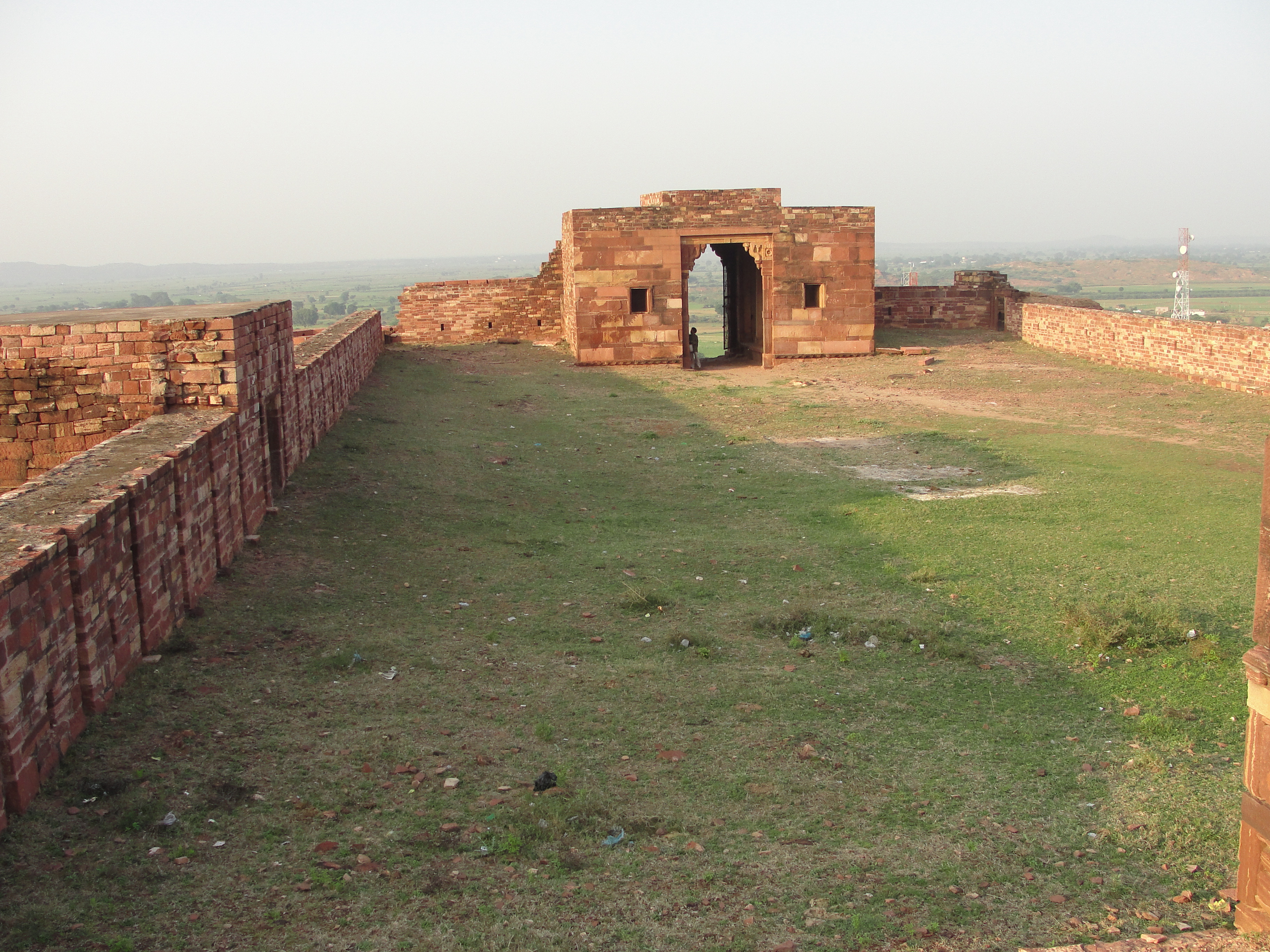
Jagner in which a Fort, Gwal Baba Temple and Baoli lie, is situated on a hill at a distance of approx. 50 km south-west of Agra and around 30 km from the famous world heritage site Fatehpur Sikri.

Geographical setting

The geographical locaiton of Jagner is composed of ridges of the upper Vindhyan ranges. These ridges are composed of sandstone layers. Jagner was formerly called Unchwan Khera. The main building material of the fort is red sandstone slabs, sourced locally.
Historical setting

The fort was built by Jagmal Rao, a Panwar chieftain in 1572 C.E. A stone inscription in Sanskrit dated samvat 1627 (1571 C.E.) assigns the fort to Rajput Panwars.
Architecture


The main entrance of the fort incorporated at the north leads to a rectangular enclosure which has at each angle and at the middle of each long side, a stone bastion. All complexes inside the fort are interconnected through a gateway. Another structure which is fairly preserved condition is Diwan-i-Am complex.
Remains of a residential complex are also located inside. The Rani Mahal of this complex once consisted of seven storeys is now one storied structure. To the north-east and outside the gateway is located a large Baoli, cut out of solid rock by Maharaja Surajmal, the Jat ruler of Bharatpur.
The Gwal Baba temple


The Gwal Baba temple lies beyond the fort. To the south-eastern side of the fort is situated the temple of Gwal Baba which has one room of modest composition. From the stone surface, molded brackets are projected out at the façade of the temple.
Nearby heritage
Near the town of Jagner lies another tank excavated by Ali Vardi Khan in the days of Akbar, but this has silted up.
Protection of the heritage site

The Jagner Fort and Gwal Baba temple were declared nationally protected monument under Government of India on 25th October, 1916.
Conservation measures taken by Archaeological Survey of India, Agra circle


Archival Sources of Jagner Fort


In Alexander Cunningham’s report of ‘A tour in Eastern Rajputana’ from the year 1871-72 and 1872-73 we can find archival information about Jagner fort and temple. See more here.
Thus, Jagner, a town located approximately 50 km southwest of Agra, features a fort, Gwal Baba Temple, and Baoli. The fort, built in 1572 C.E., is made of red sandstone and includes a well-preserved Diwan-i-Am complex. Nearby heritage sites include a tank excavated during Akbar’s reign. The Archaeological Survey of India, Agra circle, oversees conservation efforts.


Please send your valuable feedback