
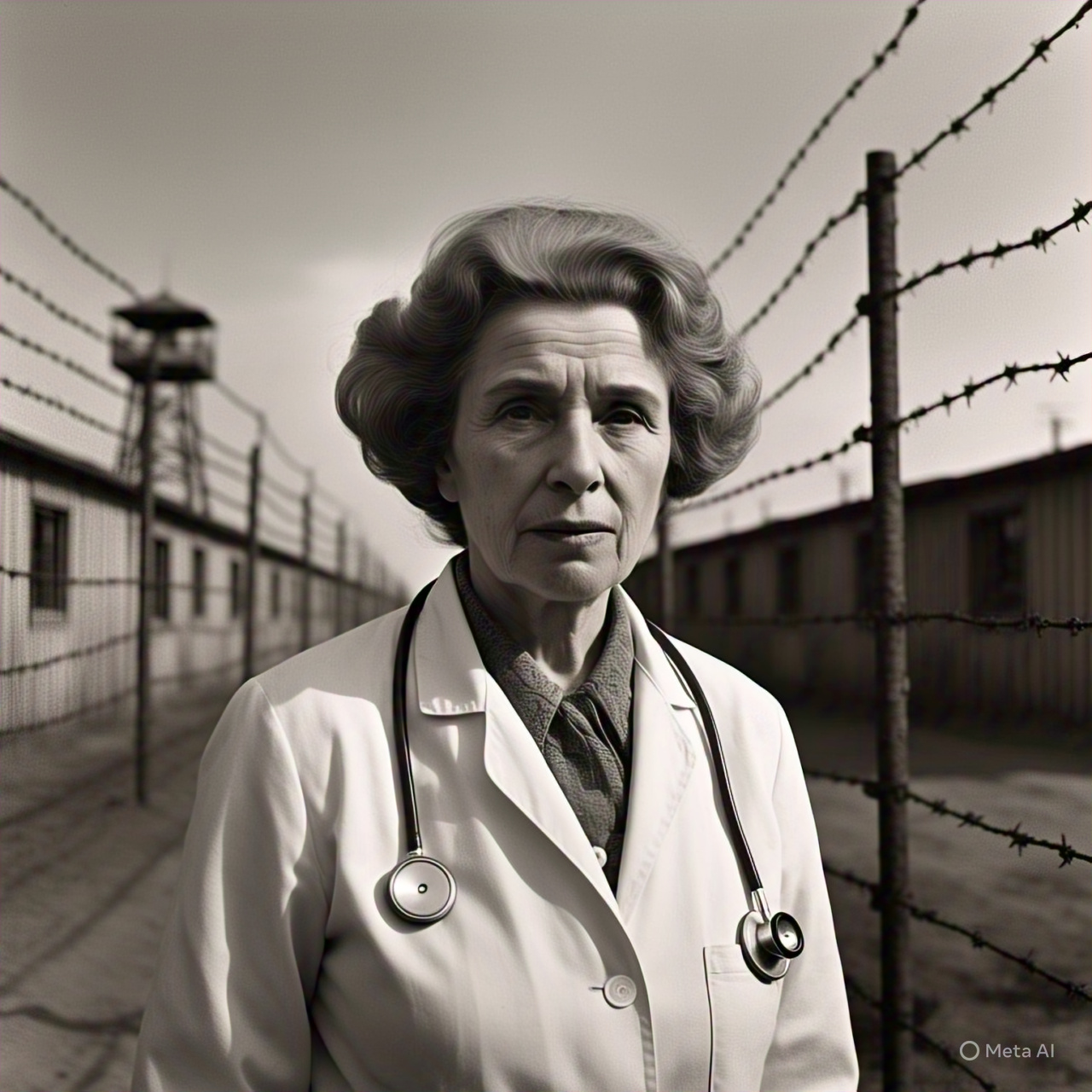
Introduction: A Voice from the Abyss
There are books that educate, books that move, and then there are books that sear themselves into the soul. I Was a Doctor in Auschwitz by Dr. Gisella Perl belongs to the third kind. First published in 1948, this harrowing memoir is a testament to the power of survival, the brutality of unchecked evil, and the quiet, unshakable resilience of a woman who was both witness and healer amidst one of the darkest periods in human history.
Gisella Perl was a Jewish gynecologist from Romania who was deported to Auschwitz in 1944. Stripped of her family, dignity, and tools of her profession, she was assigned the unthinkable task of practicing medicine in a death camp under Josef Mengele, the infamous Nazi doctor known as the “Angel of Death.” Her account is not only an extraordinary story of survival—it is also a deeply personal and painful chronicle of moral dilemmas, courage, and the enduring power of the human spirit.
First Betrayal And Many A Deaths…


The book begins in the cold of December 1943, when the author fist met a German gentleman, Dr. Kapezius in Transylvania. He gained the trust of the author and her family by claiming to be in favour of a united Germany and against Nazism. Five months later, Perl (who was arrested by the Gestapo in March 1944 and sent to a Ghetto) met him again at Auschwitz (after travelling in a cramped cattle car for eight days) where he was the camp commander and appointed her the ‘camp gynecologist’. During her time in the Ghetto, Perl predicts the future that, “only death was to deliver us from our suffering”. Throughout the book, Perl recounts the fear of selection and brutal deaths of many a Elizabeths, Julikas, Jeanettes, Charlottes, Roses, Katis, Lilys, Ibis, Bettys, etc.
Towards the end, Perl mentions a brief account of Belsen Bergen, where she was transferred to in January 1945:

“Belsen Bergen was the terminal. It was supreme fulfillment of German sadism and bestiality. Belsen Bergen can never be described, because every language lacks the suitable words to depict its horrors. It cannot be imagined, because even the most pathological mind balks at such a picture. One must have seen those mountains of rotting corpses mixed with filth, with human excrement, where once in a while one noticed a slight movement caused by rats or by the death convulsion of a victim who had been thrown there alive. One must have smelled the unimaginable stench which lay over the camp like a thick cloud shutting out the air. One must have heard those unearthly screams of. agony which continued through the day and the night, coming from hundreds of throats, unceasingly, unbearably….”
After living through and witnessing the horrors of Holocaust, of German Culture, Perl says;
“Let no one speak to me of German culture, German civilization! Belsen Bergen was the faithful portrait of German civilization -Belsen Bergen mirrored the German soul ….”

A Doctor Without Tools, A Woman Without Rights
From the very first page, Perl sets the tone with unflinching honesty:
“The greatest crime in Auschwitz was to be pregnant. Pregnant women were sent to the gas chambers immediately.”
The knowledge that her patients would be executed for carrying life forced Dr. Perl into an impossible role—she had to perform secret, silent abortions in unsanitary, cramped conditions on the toilet floor and in the darkness of the night using only her bare hands. There was no anesthesia, no instruments, no antibiotics—just sheer determination to give these women a chance at life.
It is easy to romanticize the idea of a “heroic” doctor, but Perl offers no such comfort. She does not hide behind noble and altruistic labels. Instead, she confronts the hard hitting truth: she saved lives by terminating potential ones. It is one of the most ethically difficult realities in the memoir, and Perl does not shy away from its horror. She simply asks us to look. And not look away. She writes this so that the world remembers that Yes, this happenend!
Writing Through Trauma: A Survivor’s Narrative
Unlike other memoirs that may rely on reflective distance, Perl wrote this book shortly after the war, which gives the narrative an immediacy and rawness that is difficult to describe. Her prose is simple, clear and devoid of colour. You can feel her pain etched between the lines:
“I could not cry. I could not even pray. I had to survive. If I did not survive, there would be no one left to tell the world what had happened in Auschwitz.”
This is a key sentiment repeated in many Holocaust survivor accounts—that the burden of memory is sometimes heavier than the trauma itself. Perl did not survive for herself; she survived to testify. And testify she did, not only through this book but also in courtrooms and public appearances.
Encountering Mengele: The Devil in a White Coat
One of the most chilling aspects of the book is her interactions with Dr. Josef Mengele, who ruled the women’s camp with a terrifying blend of charisma and cruelty.
“He was always smiling. Even when he selected people for the gas chambers, his face wore a strange, cruel smile.”
Perl paints Mengele not as a madman but as someone entirely lucid—and that makes him all the more terrifying. The way he perverted medicine for sadism and ideology turns the entire idea of healthcare on its head. He forced Dr. Perl to treat women only to make them temporarily fit for labor before they were sent to their deaths. Even caring for patients became a twisted game in Mengele’s control.
Auschwitz’s Women: Strength, Solidarity, and Silent Suffering

Perhaps one of the most powerful aspects of this memoir is its portrayal of women—not just as victims, but as sources of extraordinary strength. In one unforgettable passage, Dr. Perl describes how women would share scraps of bread or whisper words of comfort despite knowing that death was around the corner.
“In Auschwitz, I saw women with no food give up their last piece of bread for another. I saw mothers hold their dead children and still find the strength to go on.”
These moments remind us that even in a place designed to dehumanize and strip away one’s being, people found ways to be human. And it was often women who carried that torch in silence in this grim place.
Acts of Resistance and Mercy

While we often associate resistance with armed uprisings, Perl shows us that mercy itself was a form of resistance in Auschwitz. Saving one life—just one—was defiance. When she secretly performed abortions or gave whispered medical advice in the latrines, she was resisting. When she offered a dying woman water, when she bore witness to suffering instead of turning away, she was resisting.
“I had no instruments, no medications, no nothing. But I had my hands. And I used them.”
That line, perhaps more than any other, captures the stark heroism of her work. She saved hundreds of women with nothing but her bare hands and relentless will.
The Aftermath: Guilt, Grief, and the Fragile Art of Living

Survival, as many Holocaust survivors have shared, comes with its own set of torments. When Perl was liberated, she learned that her entire family—her husband, son, parents—had been murdered. Her grief was so profound that she attempted suicide.
“I did not want to live. I wanted to die and be with my child.”
The fact that she eventually rebuilt her life—emigrating to the United States, resuming her medical practice, and delivering thousands of babies—is nothing short of remarkable. But the shadows of Auschwitz never left her.
Style and Structure: Brief but Monumental
At around only 121 pages, I Was a Doctor in Auschwitz is not a long book, but every page is packed with emotional and historical weight. The prose is unadorned, almost clinical at times—but this is precisely what makes the book so powerful. It doesn’t need metaphor or flourish. The reality is unbearable enough.
The memoir is loosely chronological, moving from her arrival in Auschwitz to her work in the camp, and ending with liberation and her eventual recovery. There are no footnotes or historical references—this is a deeply personal account, not an academic one.
And yet, it is indispensable history.
Why This Book Still Matters Today
In a time when Holocaust denial is on the rise and human rights are increasingly under threat across the globe, I Was a Doctor in Auschwitz is not just a memoir—it is a warning. It teaches us about the consequences of dehumanization, the dangers of ideologies taken to extremes, and the resilience of the human spirit in the face of total evil.
It also forces us to reflect on the meaning of ethical practice in medicine and the moral dilemmas faced by those who are forced to choose between evils.
“I was not a doctor anymore. I was a savior of the damned.”
This line hits like a thunderclap. In the midst of horror, Gisella Perl chose to be human. That choice, repeated hundreds of times in filthy bunks and dark barracks, reverberates across generations.
Conclusion: Read This Book, Then Pass It On
If you have never read a Holocaust memoir before, start here. If you’ve read dozens, read this one anyway. Dr. Gisella Perl’s story deserves to be known, taught, and remembered. Not just for what she endured, but for how she endured it—with compassion, courage, and the unwavering belief that even in the heart of hell, one can still choose to do good.
Her memoir is more than just a recounting of trauma—it is a blueprint for moral courage. And in today’s world, we need that more than ever.
Select Quotes from the Book
- “Pregnancy was a crime. And I, a doctor sworn to preserve life, had to destroy it again and again.”
- “The ovens never stopped smoking. And the smell of burning flesh was the air we breathed.”
- “To survive in Auschwitz, one had to stop feeling. But I never could.”
- “Every woman I saved, I remember. I remember their eyes, their fear, their hope.”
Rating: ⭐⭐⭐⭐⭐ (5/5)

I Was a Doctor in Auschwitz is not an easy read—but it is an essential one. I must admit it was one of the most difficult reads of my life. Each page was more harrowing and traumatising than the last and I had to take several breaks to reach the end. This book will break your heart, reshape your understanding of human cruelty and resilience, and leave you in awe of a woman who used her hands to heal in a world designed to destroy.
Photograph Credits
https://encyclopedia.ushmm.org/en


Please send your valuable feedback